
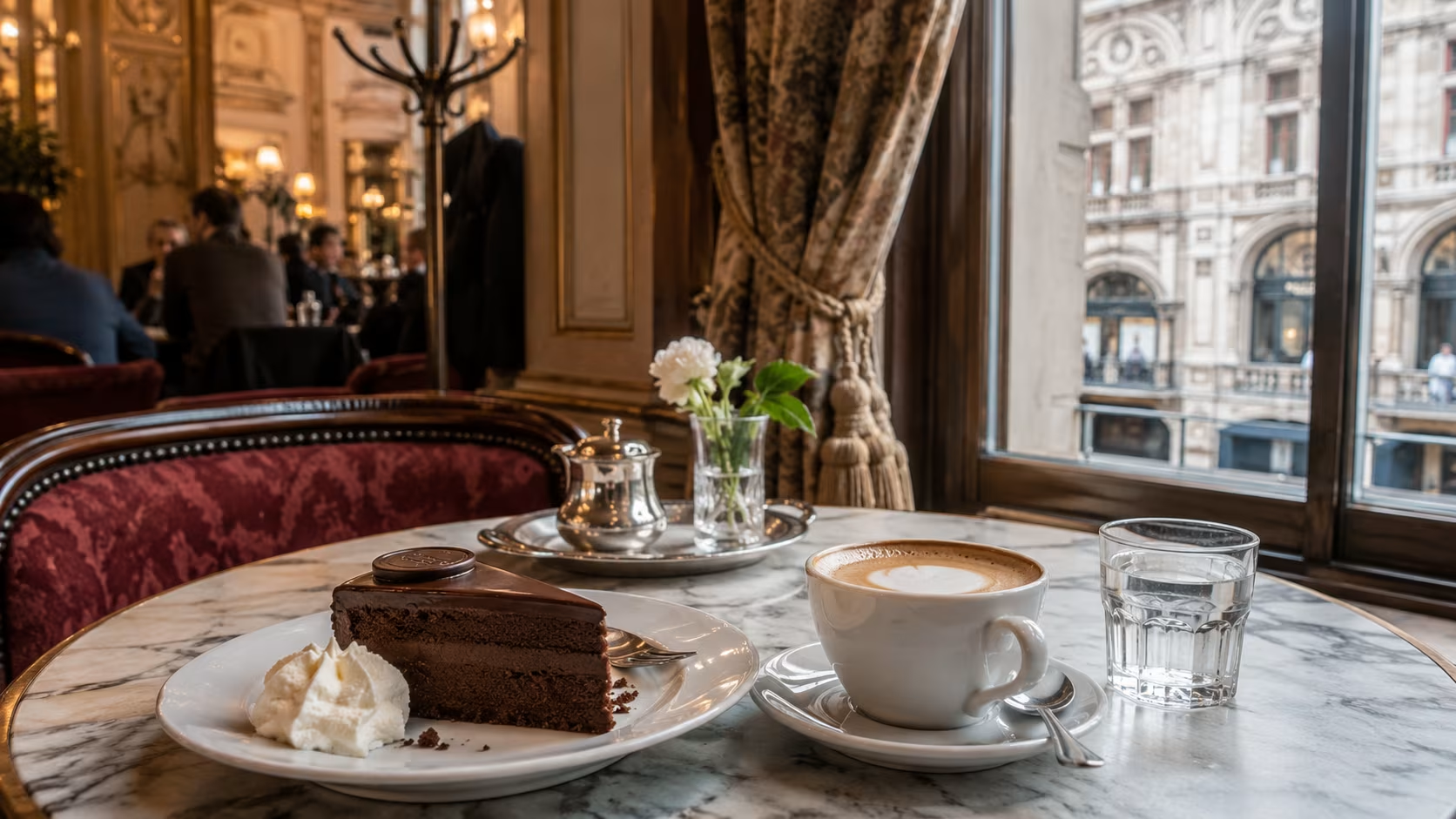
Vienna keeps winning rankings as the world's most livable city, year after year, in a way that has started to embarrass even the Viennese. The actual experience as a tourist is more interesting than the rankings suggest: a city of imperial palaces, a coffee-house culture that UNESCO has recognized as intangible cultural heritage, world-class music, and a public transit system that runs on time the way other cities aspire to.
It's also a city that refuses to hurry. Servers don't rush you. Coffee houses still expect you to spend 90 minutes with one melange and a newspaper. The pace is the cultural product as much as anything physical.
This is a 4-day guide for first-timers who want the headline imperial sights, the proper coffee-house experience, and at least one slow afternoon doing what locals do.
Quick Facts
| Item | Detail |
|---|---|
| Country | Austria |
| Currency | Euro (€) |
| Language | German (Austrian variant); English widely spoken |
| Time zone | CET (UTC+1) / CEST (UTC+2) |
| Tourist tax | 3.2% of room rate |
| Best time | April–June, September–October |
| Visa | Schengen, 90 days for most non-EU |
| Trip length | 3–4 days |
When to Go
April to June. Sweet spot. Trees in flower, palace gardens at their best, average highs 16–24°C. Vienna Festival (Wiener Festwochen) in May–June is a major cultural event.
July to August. Hot (sometimes 32°C+) and tourist-dense. Many Viennese leave for Heuriger (wine taverns) in the suburbs or for the Mediterranean. Some restaurants close part of August.
September to October. The other prime window. Weather mild, schools resumed, Vienna Wine Hike in September connects suburban vineyards.
November to February. Cold, often gray. Christmas markets (Rathausplatz, Schönbrunn, Spittelberg) are real local events with serious mulled wine. New Year's Eve in Vienna is a major destination; Imperial Ball season runs January through Carnival.
Avoid
- Easter weekend (museums closed, restaurants packed).
- Vienna State Opera Ball night (last Thursday of Carnival, late February). Hotel rates triple.
- New Year's Eve unless that's specifically what you're coming for.
Getting in
Vienna International Airport (VIE), 18 km southeast of the city.
From VIE to Central Vienna
- City Airport Train (CAT): €15 one-way, 16 minutes to Wien Mitte. Premium speed, less interesting otherwise.
- S-Bahn S7: €4.40, 25 minutes to Wien Mitte. The default for most travelers.
- Vienna Airport Lines bus: €11, 20–60 minutes to various central stops.
- Taxi: €40–55 to Innere Stadt.
- Uber/Bolt: €30–45.
Vienna is also a major rail hub. Direct trains to Munich (4 hours), Prague (4 hours), Budapest (3 hours), Zurich (8 hours), Venice (8 hours).
Getting Around
Vienna's public transit (Wiener Linien) is genuinely excellent. U-Bahn, trams, buses, all on time, all clean.
Tickets
- Single ride: €2.40
- 24-hour pass: €8
- 48-hour: €14.10
- 72-hour: €17.10
- Weekly: €17.10 (the deal: Mon–Sun, equal cost to 72-hour but covers more days if your trip overlaps the week)
- Vienna Pass + transit: €70+, usually a money-loser for casual sightseers
Buy at machines in stations, the Wiener Linien app, or any tobacco shop. Validate the paper ticket in the stamping machines before boarding.
Vienna is honor-system; ticket inspectors do random checks. Fine: €105.
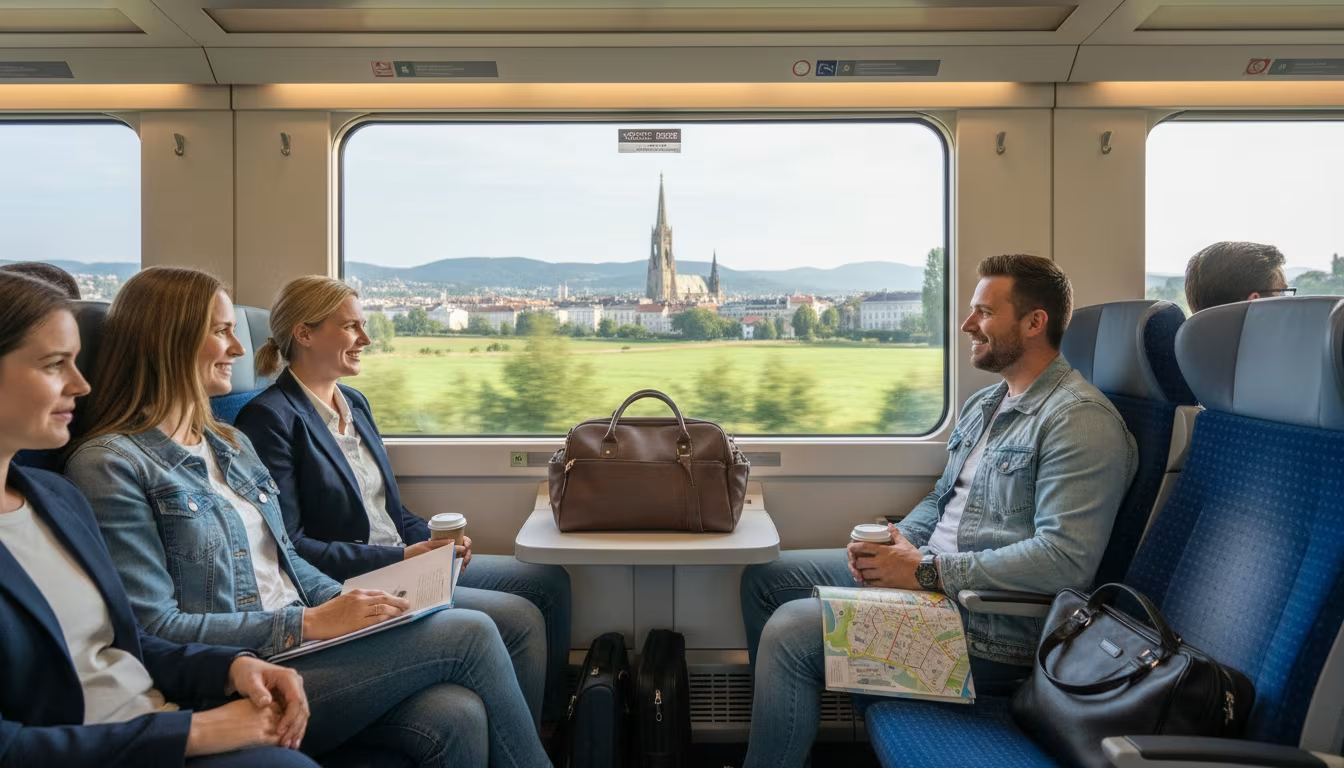
Trams are the headline. The Ringstraße tram circuits (lines 1, 2, D, 71) loop around the central historic core, a 30-minute ride past most of the imperial buildings.
Bicycles. Citybike Wien offers free first hour rides at 100+ stations citywide. Good infrastructure on the Ringstraße and along the Danube.
Walking. Innere Stadt to MuseumsQuartier to Karlsplatz: 1.5 km, all walkable. The Ringstraße loop on foot takes about 90 minutes including stops.
Where to Stay
Vienna's neighborhoods (Bezirke) are numbered 1 to 23 in concentric rings outward.
1st District (innere Stadt)
The historical core inside the Ring. UNESCO World Heritage. Walking distance to everything imperial: Hofburg, St. Stephen's Cathedral, State Opera. Hotel prices premium. Stay here for sightseeing convenience; expect tourist density.
7th District (neubau)
West of the Ring, the bohemian-shopping district. Spittelberg's small lanes, MuseumsQuartier on its eastern edge, Mariahilferstraße shopping street to the south. Walking distance to most central sights. Best first-timer pick after Innere Stadt.
4th District (wieden)
South of the Ring, residential with a strong café culture. Karlsplatz on its northern edge. Naschmarkt food market on its border with the 6th. 15 minutes to Innere Stadt.
6th District (mariahilf)
West of the 4th, similar feel, slightly larger. Mariahilferstraße runs along its northern edge.
8th District (josefstadt)
Northwest of the 7th. Quieter, more residential, second-hand bookshops and small cafés. Walking distance to MuseumsQuartier.
9th District (alsergrund)
North of the Ring, university district, more student energy. Sigmund Freud Museum (the actual Berggasse 19 apartment).
Avoid as a Base
- 2nd District (Leopoldstadt): rapidly improving, but still mixed. Riverside in summer is fine; otherwise stay in 1, 4, 6, 7, 8.
- Far districts (15, 19+): too far for a 4-day trip.
Realistic 2026 nightly prices (4-star, weekday, shoulder):
| District | Mid-range | Higher-end |
|---|---|---|
| 1st (Innere Stadt) | €230–340 | €450–900 |
| 4th (Wieden) | €160–240 | €330–550 |
| 6th (Mariahilf) | €140–220 | €290–480 |
| 7th (Neubau) | €170–260 | €350–600 |
| 8th (Josefstadt) | €140–210 | €280–460 |
What to Book in Advance
Schönbrunn Palace
The Habsburg summer palace, 7 km from central Vienna. Two routes: Imperial Tour (22 rooms, 35 minutes, €25) or Grand Tour (40 rooms, 55 minutes, €31). Book online for timed entry; the line at the door can run 60+ minutes in summer. The gardens are free and worth the half day.
Hofburg Imperial Apartments
The winter palace at the center of Vienna. €18.50 covers Imperial Apartments + Sisi Museum + Silver Collection. Walk-up usually fine; book online to skip the queue.
Albertina
The imperial collection of works on paper (Dürer, Klimt, Picasso). €19. Walk-up usually fine.
Belvedere (Klimt's The Kiss)
Upper Belvedere holds the famous Klimt collection including The Kiss and Judith. €17. Lower Belvedere has temporary exhibitions, €17. Book online: The Kiss is the most photographed painting in Austria and the queue is real.
Vienna State Opera
The Staatsoper sells four kinds of tickets:
- Regular seats: €15–250+, book months ahead for popular nights
- Standing tickets (Stehplätze): €10–18, sold the same day starting 80 minutes before curtain at the standing box office. Genuinely worth doing: you can see a world-class opera for €15. The line forms 1–2 hours before sales open.
- Backstage tour: €13, multiple daily, no booking needed
- Live screening on Karajan-Platz: free, for sold-out performances, big screen outside the building
Spanish Riding School
The Lipizzan stallions perform morning exercises (€16, daily) and full performances (€44–185, less frequently). Both book ahead.
Vienna Boys' Choir
Sings Sunday Mass at the Hofburg Chapel (Hofburgkapelle). €15–37. Book ~4 weeks ahead.
Day 1 — Imperial Vienna
08:30. Coffee at a proper Viennese coffee house. Café Central, Café Sperl, Café Hawelka, Café Bräunerhof. The melange (Viennese cappuccino with whipped foam) is the standard order. Don't rush.
10:00. St. Stephen's Cathedral (Stephansdom). Free entry to the nave; €6 to climb the south tower (343 stairs, no elevator, the original); €6.50 elevator to the north tower (with the Pummerin bell, the largest free-swinging bell in Austria). Climb one. The roof tiles are a Vienna postcard image.
11:30. Walk to the Hofburg via Graben (the wide pedestrian shopping street with the Plague Column). Then through Kohlmarkt to the Hofburg.
12:00. Hofburg Imperial Apartments + Sisi Museum + Silver Collection. €18.50. Allow 2 hours. The Sisi material is uneven (the Empress Elisabeth myth is heavy here), but the Silver Collection (10,000 pieces of imperial porcelain and gold) is stunning.
14:30. Lunch in or near the Hofburg. Trzesniewski for open-faced sandwiches (a Viennese institution since 1902). Plachutta for Tafelspitz, the classic Viennese boiled beef.
16:00. Spanish Riding School morning exercises if scheduled (Tue–Fri 10:00–12:00 most weeks; check current calendar).
17:00. Walk through Heldenplatz, the Volksgarten (rose garden), the Burggarten (with the Mozart statue and the Palmenhaus tropical butterfly house, €7).
19:30. Dinner. Steirereck (two-Michelin-star, book months ahead) for the headline. Plachutta mentioned above. Figlmüller for the city's most famous schnitzel (the original location near Stephansdom, mid-tier prices, queues real).
Day 2 — Museums
Path A: Old Masters
09:00. Kunsthistorisches Museum (KHM). The imperial art collection. €21. Allow 4 hours. The Bruegel collection (12 works, the world's largest) is the headline; the Egyptian and Roman collections are also serious.
13:00. Lunch at the museum's central café (Kuppelsaal, under the dome) or nearby.
14:30. Across Maria-Theresien-Platz to the Naturhistorisches Museum (twin building, natural history). Or skip and walk to MuseumsQuartier for modern art.
Path B: Modern Art
09:00. MuseumsQuartier. The Leopold Museum (€17) holds the world's largest Schiele collection plus major Klimt. Allow 2 hours. mumok (Modern Art Museum, €15) for 20th-21st century. Allow 90 minutes.
12:30. Lunch in MuseumsQuartier, with multiple cafés in the courtyards.
14:30. Belvedere. Upper Belvedere (€17) for The Kiss and Klimt. The Lower Belvedere often has temporary exhibitions.
17:00. Walk back through the Belvedere gardens.
19:30. Dinner in the 4th or 6th district, both an easy walk from Belvedere.
Day 3 — Schönbrunn and Coffee Houses
09:00. U-Bahn to Schönbrunn (line U4, 20 minutes from city center).
09:30. Schönbrunn Palace, Grand Tour. €31. Allow 75 minutes inside.
11:00. Schönbrunn Gardens. Free. Walk to the Gloriette (the triumphal arch on the hill) for the city skyline view. The Privy Garden, Maze, and Tiergarten (the imperial zoo, the world's oldest, €27) are all on-site.
13:30. Lunch at the Café Gloriette in the hilltop arch, or back near the entrance.
14:30. U-Bahn back to central Vienna.
15:30. Proper coffee-house afternoon. Pick one and stay 90 minutes:
- Café Central: Trotsky's regular, ornate, touristy but genuinely beautiful
- Café Sperl: quieter, billiards table, the closest thing to a 1900s atmosphere
- Café Hawelka: small, smoky-feeling without smoke, jazz-and-poetry history
- Café Bräunerhof: Thomas Bernhard's regular, less polished, properly Viennese
- Café Landtmann: across from the Burgtheater, the largest, the most famous
Order a melange (€5–6), a small pastry (€4–7), and a glass of water. The waiter will leave you alone for an hour.
17:30. Walk through the Innere Stadt streets you haven't seen.
19:30. Dinner. Glacis Beisl in MuseumsQuartier for casual Austrian. Kim Kocht for upscale Asian. Heunisch & Erben for Austrian wine cellar.
Day 4 — Choose: Naschmarkt, Heuriger, or Day Trip
Path A: Naschmarkt and Mariahilferstraße
10:00. Naschmarkt, the city's main food market, between the 4th and 6th districts. Open Mon–Sat. The eastern half is the produce/meat/cheese market; the western half is the prepared-food and restaurant strip. The Saturday flea market on the western end is a real event.
12:30. Lunch at the Naschmarkt. Neni for Israeli-influenced. Umar Fisch for Mediterranean fish. Naschmarkt Deli for casual.
14:00. Walk Mariahilferstraße, the city's main shopping street. 1.6 km of mostly mid-tier shops, ending at Westbahnhof.
16:00. Optional: Karlskirche (St. Charles's Church). The 18th-century baroque church with an internal elevator (€10) up to the dome for close-up frescoes. Not on most first-timer lists; striking.
Path B: Heuriger Wine Tavern
Vienna is one of the few major cities with active vineyards inside city limits. Heuriger ("this year's wine") taverns in the suburbs are where locals drink in summer. Tram 38 from Schottentor to Grinzing (the most famous Heuriger village).
14:00. Walk through Grinzing village. Pick a Heuriger: Mayer am Pfarrplatz (Beethoven once lived here), Weingut Reinprecht, Heurigenrestaurant Sirbu (uphill, with the best view).
14:30 onward. Order Sturm or Heuriger wine, a Brettljause (cold cuts and bread platter), and stay for the afternoon. The Heuriger atmosphere is the cultural product.
18:00. Walk uphill from Grinzing through Vienna Woods to Kahlenberg viewpoint. 45 minutes uphill; spectacular view down on the city.
20:00. Bus back to Heiligenstadt then U-Bahn to center.
Path C: Day Trip to Bratislava
Bratislava is 65 km away, 70 minutes by train (€16 round-trip). A different country (Slovakia), a different feel (smaller, less polished, more intimate). Castle, Old Town, Slavin memorial. Half day or full day. UFO Bridge has the city's best viewpoint.
What to Eat
Viennese cuisine has been more refined than Berlin's for centuries. The classics stay on menus; the modern wave has produced a real fine-dining scene.
Classic Vienna
| Dish | What it is |
|---|---|
| Wiener Schnitzel | Veal cutlet pounded thin, breaded, fried. Must be veal to be "Wiener"; pork version is Schnitzel Wiener Art. Served with potato salad and lemon. |
| Tafelspitz | Boiled beef in broth with horseradish, applesauce, potatoes. Emperor Franz Joseph's favorite. Plachutta is the institution. |
| Goulash | Hungarian-influenced beef stew. Heavier than Czech version. |
| Backhendl | Crispy fried chicken. Pre-fast-food European version. |
| Tafelspitz | Boiled beef classic. |
| Sachertorte | Chocolate cake with apricot jam. Hotel Sacher for the original; Demel for the rival version with the same name (decades-long lawsuit settled). |
| Apfelstrudel | The Austrian apple strudel, paper-thin pastry, served warm with vanilla sauce. |
| Kaiserschmarrn | Shredded sweet pancake with raisins and powdered sugar. "Emperor's mess." |
Coffee
Viennese coffee orders are specific:
- Melange: espresso with steamed milk and foam, like a cappuccino. Standard.
- Großer Brauner: large espresso with a small jug of milk on the side.
- Verlängerter: espresso lengthened with hot water (like an Americano).
- Einspänner: espresso topped with whipped cream, in a tall glass. Carriage-driver's drink.
- Kapuziner: small dark coffee with a drop of cream.
Never order a "latte" or a "cappuccino" at a traditional Viennese coffee house: the staff will be politely confused. They have their own vocabulary.
Modern Vienna
- Steirereck: two-Michelin-star, the city's headline.
- Mraz & Sohn: two-Michelin-star.
- Tian: two-Michelin-star, vegetarian-tasting.
- Konstantin Filippou: two-Michelin-star.
All book 4–8 weeks ahead.
Costs and Budget
2026 daily budgets per person, excluding flights and hotel:
| Style | Per day | Notes |
|---|---|---|
| Backpacker | €60–95 | Hostel, cheap schnitzel, walking, occasional museum |
| Mid-range | €110–170 | Mix of casual and proper restaurants, museums, transit |
| Comfortable | €200–300 | Better restaurants, opera ticket, taxis |
| Higher-end | €450+ | Tasting menus, Spanish Riding School, hotel breakfasts |
Practical Info
- Cards. Accepted almost everywhere. Cash useful at small heuriger and traditional cafés.
- Tipping. 5–10%, told to the server when paying (German pattern). Don't leave money on the table.
- English. Universal in tourist areas; common elsewhere. Older Viennese in residential districts may speak less English.
- Sundays. Most shops closed except station kiosks and bakeries. Restaurants and museums open.
- Quiet hours. 22:00–06:00. Strongly enforced; loud parties draw real complaints.
- Pickpocketing. Real on tram 1/2 around the Ring and at major sights. Standard precautions.
- Smoking. Banned indoors at restaurants since 2019; outdoor terraces sometimes allow.
Common First-Timer Mistakes
- Eating at restaurants on Stephansplatz or Graben. Tourist factories. Walk three blocks; quality jumps.
- Ordering coffee like an American. "Latte" doesn't translate. Learn melange.
- Skipping the standing tickets at the Opera. €15 for a world-class performance is a Vienna experience worth queueing for.
- Trying to do the Hofburg in 30 minutes. It's a complex of 8 museums; budget appropriately.
- Visiting Schönbrunn without seeing the gardens. The interior is 75 minutes; the grounds are 3 hours.
- Drinking espresso quickly at the bar like in Italy. Vienna coffee is a sit-down ritual; rushing it confuses everyone.
- Booking high-end Heuriger only in Grinzing. The further villages (Stammersdorf, Sievering, Mauer) are more authentic and less tourist-priced.
Final Notes
Vienna is best as a slow city. Four days at imperial pace plus one Heuriger or coffee-house afternoon is the right shape for a first trip. The mistake is to treat Vienna like Paris: checking off sights at high tempo. The Vienna that stays with you is the long melange in a half-empty café on a Tuesday afternoon, and the empty Ringstraße tram at 06:00 the morning you leave.
The quietest piece of advice: book one opera evening, even if standing. Whatever the program, the room itself is the experience.
0 Comments
No comments yet — start the conversation.