
The night flight from Brussels arrives in Kigali at 5 AM, and Kigali at 5 AM is clean. Remarkably, counterintuitively, genuinely clean. The streets are swept. The verges are trimmed. The roundabouts have flowers. A country where 800,000 people were murdered in 100 days in 1994 has, in the thirty years since, built the cleanest capital city in sub-Saharan Africa, a national conservation program for mountain gorillas that has reversed their population decline, and a female legislative majority (62%) that is the highest of any national parliament in the world. These facts sit alongside each other and don't resolve into a simple narrative, which is precisely the texture of Rwanda as a place to travel.
I came with two weeks and a clear itinerary: two nights in Kigali for the genocide memorial and context, then north to Volcanoes National Park for the gorilla trekking, then west to Lake Kivu for rest, then a slower return through the tea country of the southwest. What I came back with was more complicated than the itinerary: a country that contains its past with a particular kind of deliberate clarity and is building its future with a discipline that is both inspiring and, to some observers, unsettling. Rwanda asks you to engage with both.
A small country with a concentrated set of reasons
Rwanda is a relatively small country (roughly the size of Massachusetts) with a concentrated set of extraordinary things: the last viable mountain gorilla population shared with Uganda and DRC, a surprisingly cosmopolitan capital with serious food and a small but good museum infrastructure, and a landscape (the "land of a thousand hills" description is accurate: every view involves ridged hills layered to the horizon) that is consistently beautiful.
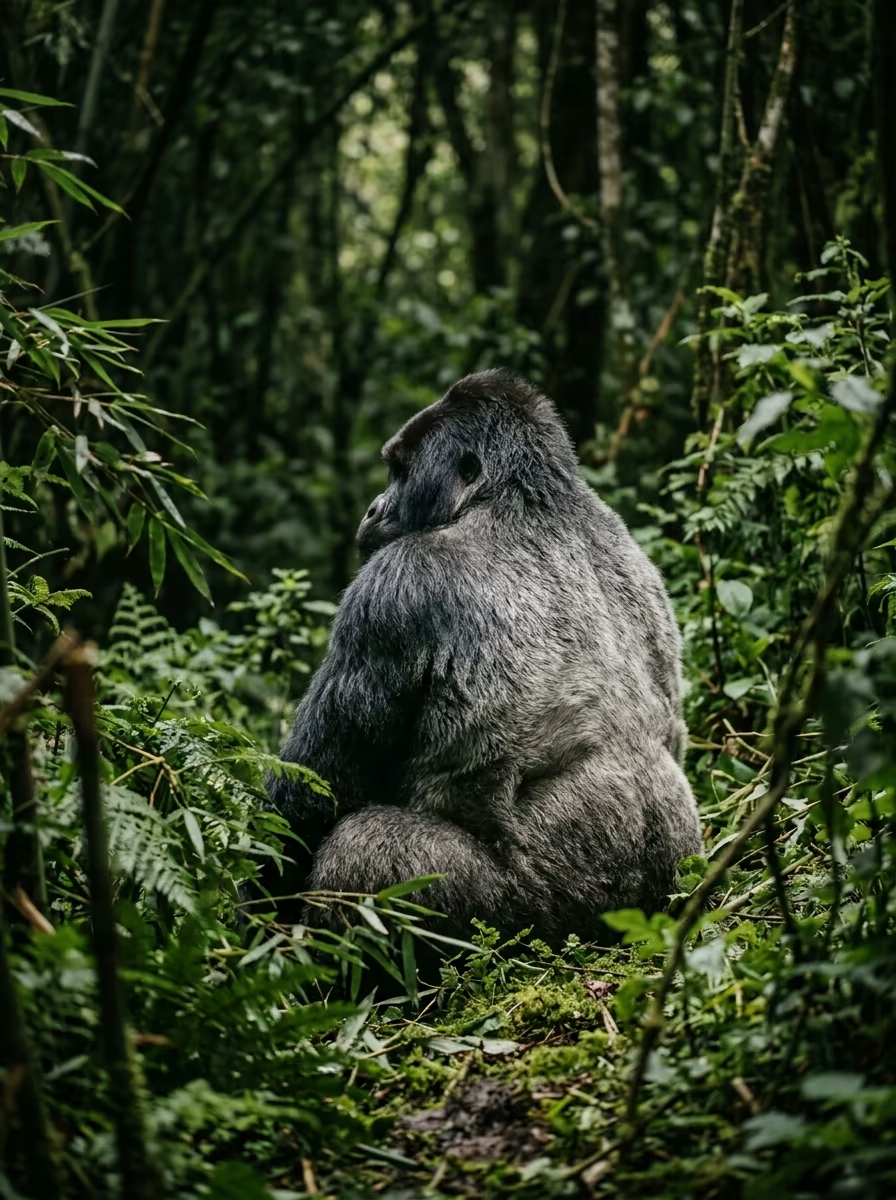
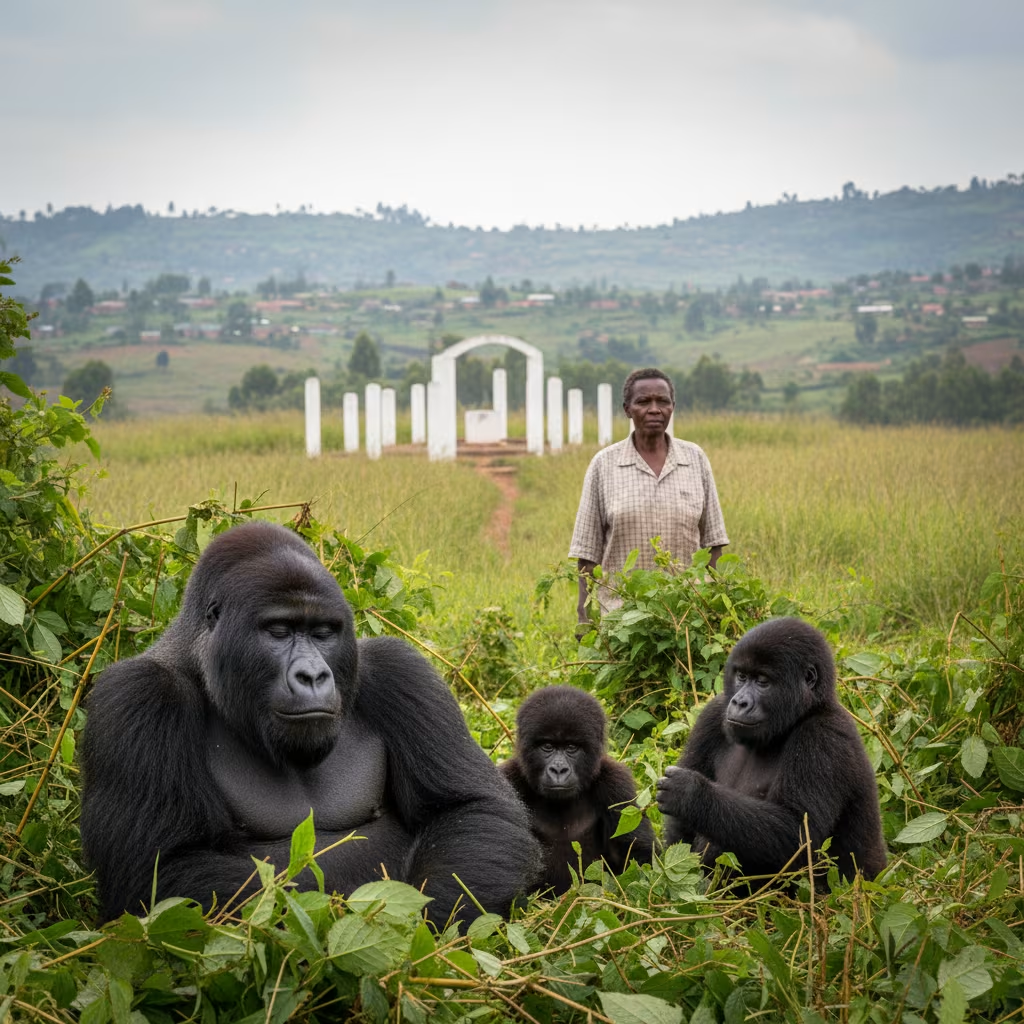
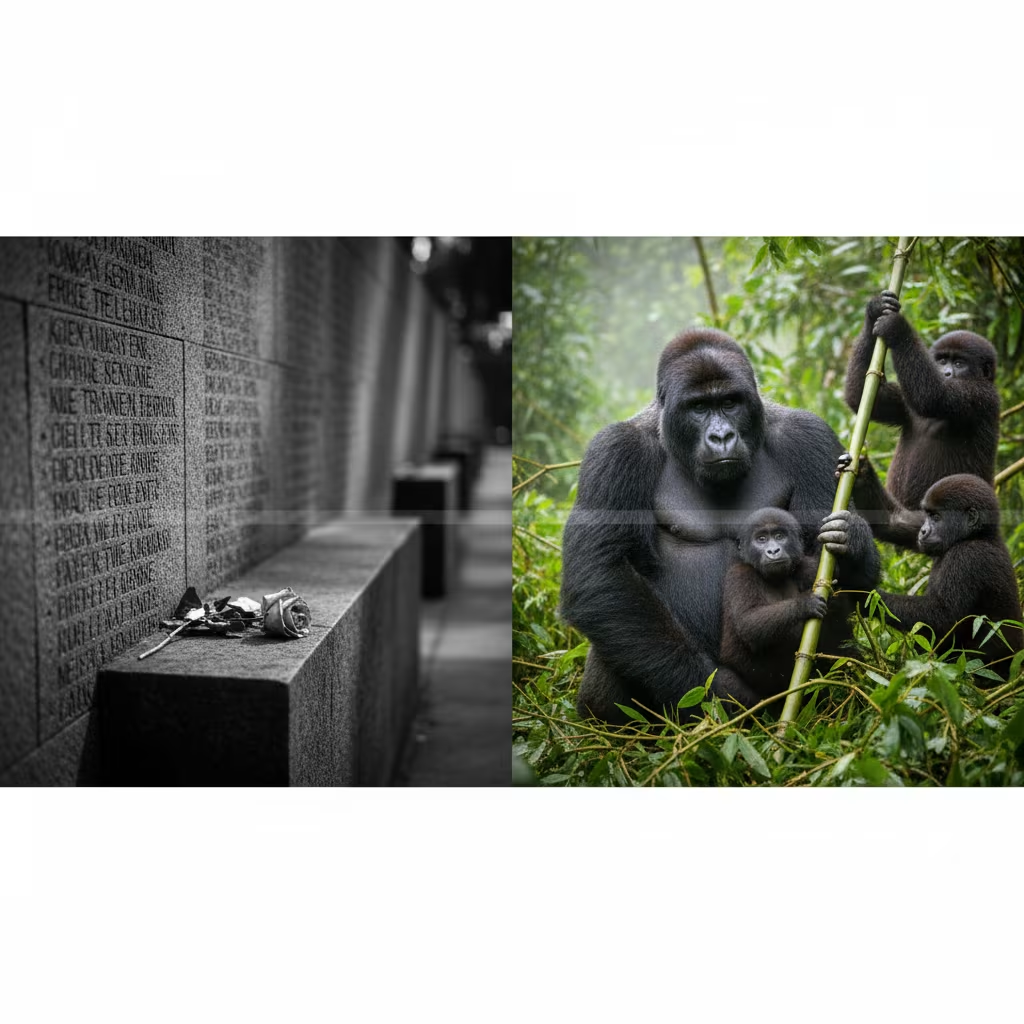
The gorilla trekking is the specific reason most visitors come, and it is worth the significant cost ($1,500 per person per gorilla permit). The experience of spending one hour with a habituated gorilla family in the Virunga volcanic highlands, sitting ten meters from a 200kg silverback who is aware of you and has decided you are not interesting, is among the genuinely unrepeatable experiences in travel. There is no zoo equivalent of this. There is no photograph that captures the scale.
Rwanda is challenging for budget travelers: the gorilla permit alone makes it expensive, accommodation in quality establishments runs $80–200/night, and the country's deliberate positioning of itself as a premium conservation tourism destination means the budget option are thinner than in comparable East African countries. It is not the right choice for travelers who need the cheapest possible African safari experience; Kenya and Tanzania offer comparable wildlife at various price points. Rwanda is for travelers who can afford the gorilla permit and want the full context (the history, the conservation story, the country itself) alongside it.
Two weeks: Kigali, the gorillas, Lake Kivu
Days 1–2: Kigali: the Memorial and the City
The Kigali Genocide Memorial is not optional. It's the correct beginning to any visit to Rwanda: a comprehensive, carefully conceived museum and burial site that documents the 1994 genocide with historical context, survivor testimony, and enough demographic specificity (photographs, names, personal effects of victims) to make the abstraction of 800,000 deaths as concrete as such an abstraction can be made. Allow three to four hours and bring water. The visit is free. Afternoon and evening in the Kimironko Market (a large, genuine local market that is not a tourist market), and dinner at Repub Lounge in the Kiyovu neighborhood, where the contemporary Rwandan and East African menu is the best in the city ($25–40/person).
Days 3–4: Volcanoes National Park Preparation and Arrival
The drive from Kigali to Musanze (gateway to the Volcanoes park) takes about two hours on a well-maintained road through the northern highlands. Check into your lodge: the lodges closest to the park headquarters range from mid-range ($150–200/night, Gorilla Nest, Kinigi Guest House) to luxury ($500–800/night, One&Only Gorillas Nest, Sabyinyo Silverback Lodge). Your gorilla permit assigns you to a specific gorilla family and a specific trekking group (maximum 8 people per family per day). The trek briefing is at the park headquarters at 7 AM on your trekking morning.
Day 5: Gorilla Trekking
The trek begins at the park boundary. The habituated families live at altitudes of 2,500–3,500m in the volcanic highland forest; the walk to them ranges from 30 minutes (if the family is near the boundary) to 5–6 hours (if they've moved deep into the forest). You have one hour with the family once you find them, regardless of the trek length. Guides are very good at placing you in the best position. The one hour passes very quickly.
Days 6–7: Lake Kivu
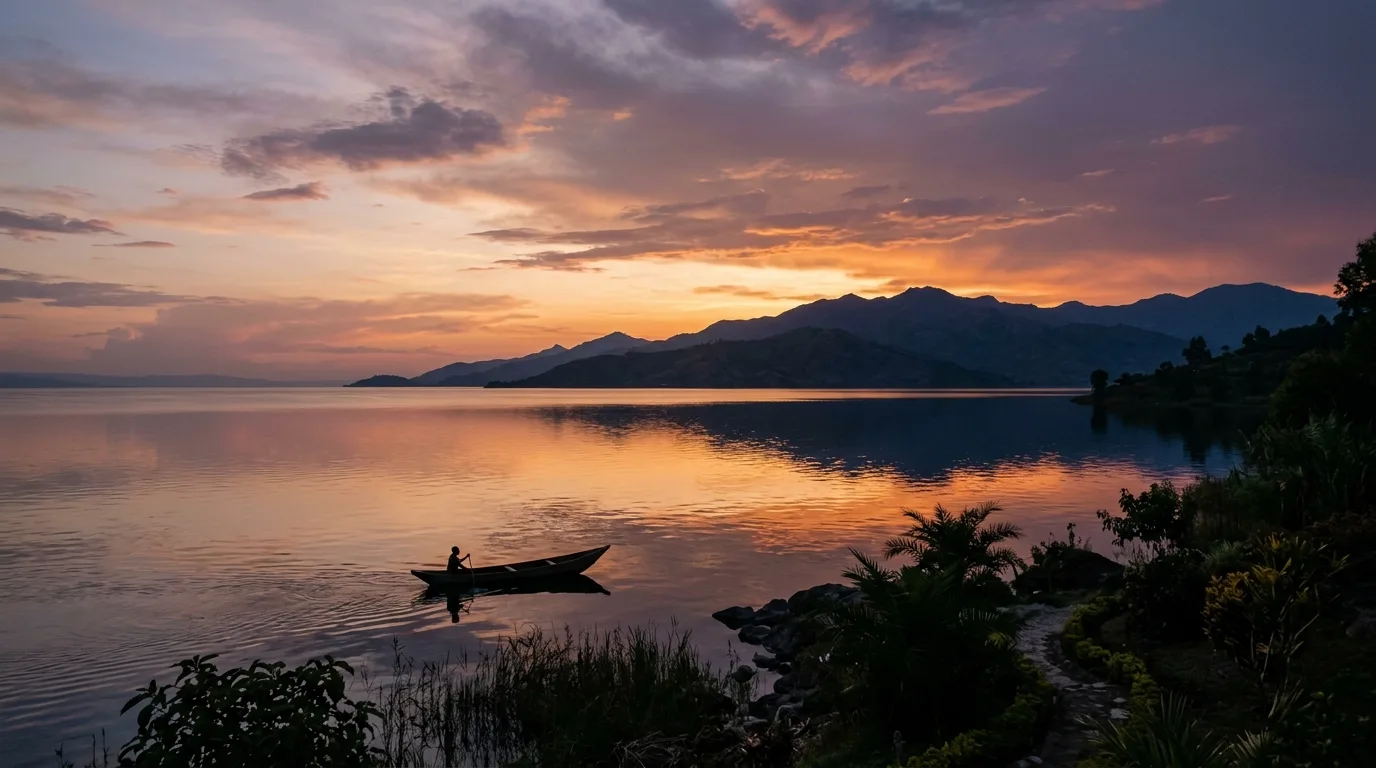
Lake Kivu is on Rwanda's western border with DRC, one of Africa's great lakes, at 1,460m altitude, with a dramatically clear high-altitude quality to the light. The town of Rubavu (formerly Gisenyi) on the northern shore has a strip of lakeside accommodation and restaurants. Kayak on the lake ($15–25/two hours), visit a local banana beer brewery, take a boat to one of the small islands. The lake is not spectacular in a wildlife sense; it's spectacular in a landscape and light sense. Two nights here is the trip's most explicitly relaxed section.
Days 8–9: Tea Country, Nyungwe and the Southwest
Nyungwe National Park in the southwest is a montane rainforest with chimpanzee trekking (permits $100/person, similar process to gorillas), a canopy walkway, and Rwanda's highest biodiversity outside the Virungas. The surrounding southwest is the country's tea growing region: the Gisakura Tea Estate and the view from the park edge over rolling tea plantations to the Albertine Rift escarpment is one of Rwanda's most beautiful perspectives.
Days 10–14: Return North, Slower Pace, or Uganda Extension
A common and logical extension: cross from Rwanda into Uganda for the Bwindi Impenetrable Forest National Park (the other gorilla trekking site, with a different landscape character). The road border at Cyanika is manageable; Ugandan gorilla permits are also $700 (less than Rwanda's $1,500). Alternatively: return to Kigali for the remaining days, exploring the arts and design scene (the Inema Arts Center in Kiyovu is a serious contemporary art space showing Rwandan and regional artists) and the improving restaurant scene. The Kigali cafe culture, particularly around the Kimihurura neighborhood, is genuinely good.
Kigali, Musanze and the lake
Kigali
The Radisson Blu is the business standard at $150–200/night. The Retreat by Heaven (a boutique hotel in Kiyovu) is a warmer option at $120–160/night with a good restaurant. Budget: The Linden Guest House at $40–60/night for a private room with breakfast, well-located in the residential Kacyiru neighborhood.
Volcanoes National Park
Accommodation spans from $150/night (Gorilla Nest Lodge, Kinigi Guest House) to $600+/night (Sabyinyo Silverback Lodge, where the community benefit premium is built into the rate). The premium lodges contribute directly to community conservation funds; the pricing model is part of Rwanda's conservation tourism strategy.
Lake Kivu (rubavu)
Serena Hotel Lake Kivu at $150–200/night on the lake. Palm Beach Eco Lodge at $60–80/night: simple, lakeside, very well positioned.
RwandAir, and driving times that stay short
Kigali International Airport (KGL) is served by RwandAir (the excellent national carrier connecting to most African capitals and European cities via partnerships), Brussels Airlines, Ethiopian Airlines, Qatar Airways, and KLM. From Nairobi, Addis Ababa, or Amsterdam, connections are straightforward.
Within Rwanda: Rwanda is remarkably compact. Kigali to Musanze (Volcanoes) is 2 hours; Kigali to Rubavu is 3 hours; Kigali to Nyungwe is 4 hours. Hire a driver for the park sections (your lodge will arrange this); buses cover the main routes cheaply. The road infrastructure is among the best in East Africa: smooth tarmac on all main routes.
A local SIM (MTN or Airtel Rwanda) is available at the airport for a few dollars and provides excellent 4G coverage throughout most of the country. The country runs entirely on Rwandan francs (RWF); US dollars are widely accepted in hotels and tourist facilities at reasonable rates. ATMs in Kigali are reliable.
The two dry seasons, and permit availability
June to September
The long dry season: the best trekking conditions, clear skies, firm forest trails. The gorilla families are more predictable in their range during dry conditions. Peak season, with permits sometimes booking 6–12 months ahead for the most popular family groups.
December to February
The short dry season. Slightly less visited, permits occasionally available with shorter notice, cheaper accommodation rates. Still good trekking conditions.
March to May and October to November
Wet seasons. Trails are muddy, trekking is harder, some mountain accommodation is difficult to access. The forest is at its most dramatically green. Permits are more easily available on short notice.
Rwanda: permits, costs and other questions
Do gorilla permits really cost $1,500?
Yes, as of 2024. Rwanda deliberately set the permit price as a conservation investment: the revenue funds ranger salaries, anti-poaching, and community benefit programs. Uganda's permits are $700; the Democratic Republic of Congo's are $400 (with significant safety considerations that make Rwanda the preferred option for most travelers). The $1,500 is fixed; there is no discount for off-season or early booking.
What level of fitness is required for gorilla trekking?
Moderate fitness is adequate for most treks. The elevation (2,500–3,500m) is the primary challenge, not the physical distance. People with significant cardiovascular or respiratory conditions should consult a doctor before booking. Porters can be hired at the park headquarters to carry your bag (and, if needed, to assist you on the trail); this is worth doing regardless of fitness level.
Is Rwanda safe to travel in?
Rwanda is one of the safest countries in Africa for tourists, with a very low crime rate and effective law enforcement. The political climate is stable (under President Paul Kagame's long-running government, with human rights concerns that are documented by international organizations and worth understanding). Crime against tourists is very rare.
What vaccinations are required?
Yellow fever vaccination is required for entry if you're arriving from a yellow fever endemic country. Recommended vaccinations include typhoid, hepatitis A and B, and routine updates. Malaria prophylaxis is recommended for the Lake Kivu region and southwest lowlands; the gorilla trekking areas at altitude (2,500m+) are generally malaria-free.
Rwanda cost sheet:
| Item | Figure |
|---|---|
| Gorilla permit | $1,500/person; max 8 visitors per family per day |
| Quality accommodation | $80–200/night |
| Lodges near park HQ | $150–200 mid-range |
| Kigali → Musanze | ~2 hours by road |
| Context | one hour with a family; silverbacks reach ~200 kg |
0 Comments
No comments yet — start the conversation.