

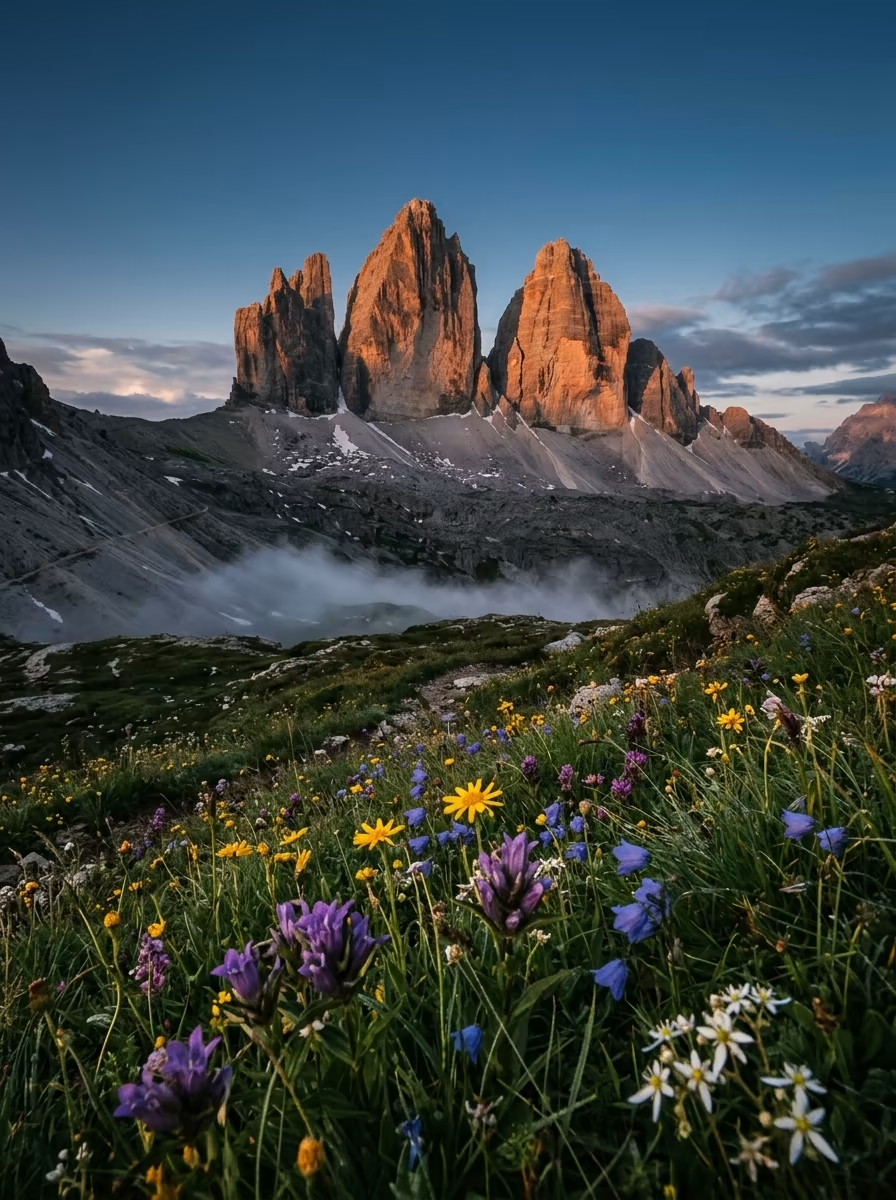
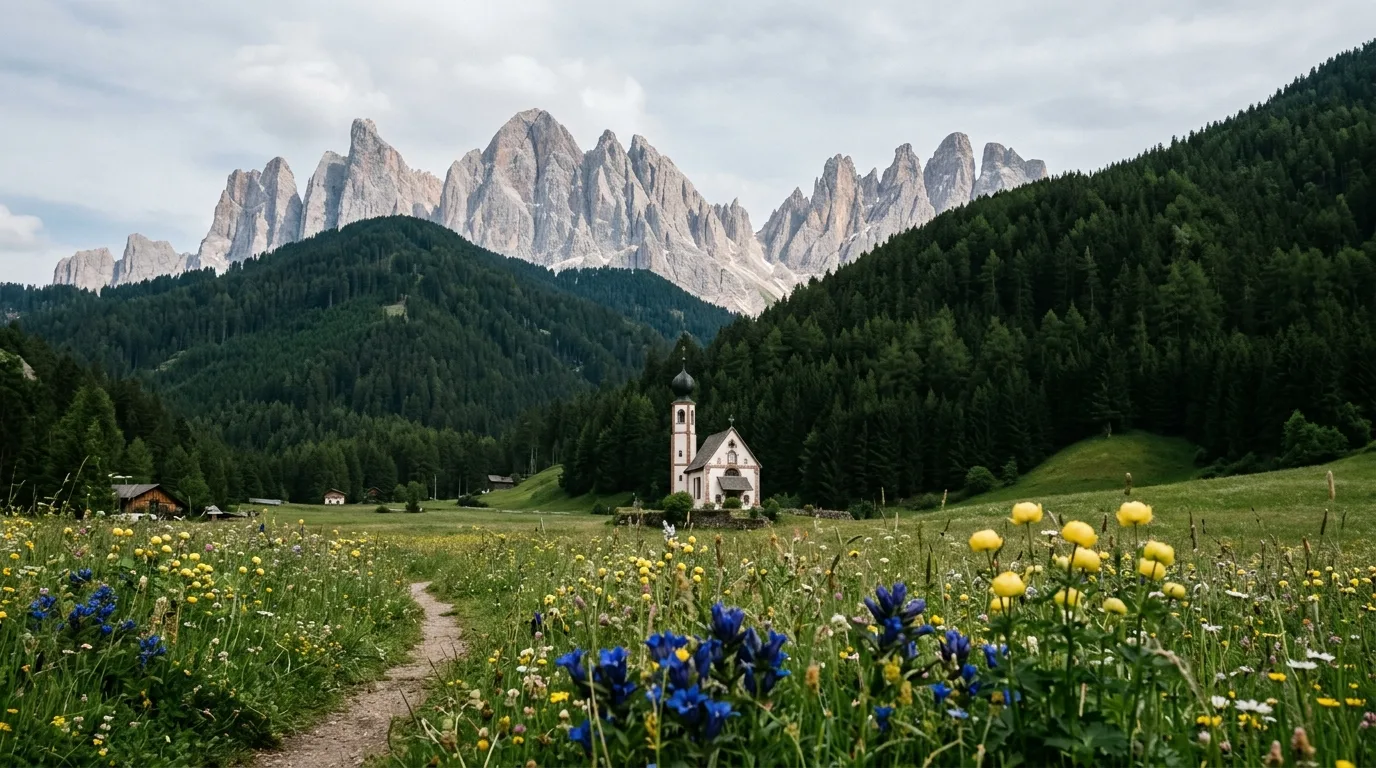
The taxi from Bolzano to Ortisei took forty-five minutes through a valley so densely green after a wet May that I kept expecting the driver to point out that we'd taken a wrong turn and ended up in the Tyrol (which, geographically speaking, we mostly had). The Dolomites are northeastern Italy by politics, South Tyrol by culture, and somewhere else entirely by landscape: a range of pale rose-gray limestone towers that rise from meadows and pine forests so abruptly that they seem to have fallen from a different planet.
I arrived on the last Sunday of May. The ski lifts had been closed for six weeks. The hiking season didn't officially open for another three. I had a trail map, a list of rifugi (mountain huts) that had confirmed they were open for the season, and approximately three other hikers visible on the first trail I walked. For the first time in four visits to this range, I understood what the Dolomites looked like before they became famous.
The week that followed is the best hiking week I've had in Europe, and this guide is my attempt to give you the conditions that made it work.
The Dolomites' problem is their own success
The Dolomites' problem is their own success. The area around Cortina d'Ampezzo and the most-photographed viewpoints (Tre Cime di Lavaredo, Lago di Braies, the Val di Funes meadows below the Odle group) is genuinely spectacular, and that spectacle now draws millions of visitors every summer. In July and August, the trail to Tre Cime is a shoulder-to-shoulder queue and parking at Lago di Braies requires arriving before 7 AM or paying €5 for a shuttle bus. The photographs you see of an empty meadow with the Geislerspitzen reflected in morning light were taken in May, September, or at 5 AM.
The answer to this problem is timing. Come in the second half of May or the first two weeks of June, after the snow has cleared from most low and mid-altitude trails, before the Italian and German summer school holidays begin in late June. The mountain huts operate on reduced hours and some have limited menus, but they are open, the trails are walkable, the wildflowers are extraordinary (larch turning, mountain meadows full of gentian and arnica), and the landscape is, not to overstate it, almost entirely yours.
The Dolomites are not the right destination if you want beach, nightlife, or a city. They are not particularly comfortable for travelers with limited hiking fitness: even the "easy" valleys involve significant inclines that comfortable shoes handle poorly. They require some logistical planning around transport (a car is strongly advisable; public buses exist but are slow and infrequent). What they offer is a mountain experience that is both architecturally dramatic and richly humanized: the rifugi, the alpine meadow culture, the South Tyrolean food and wine tradition (Lagrein, Vernatsch, Gewürztraminer), in a way that pure wilderness ranges like the Pyrenees don't quite replicate.
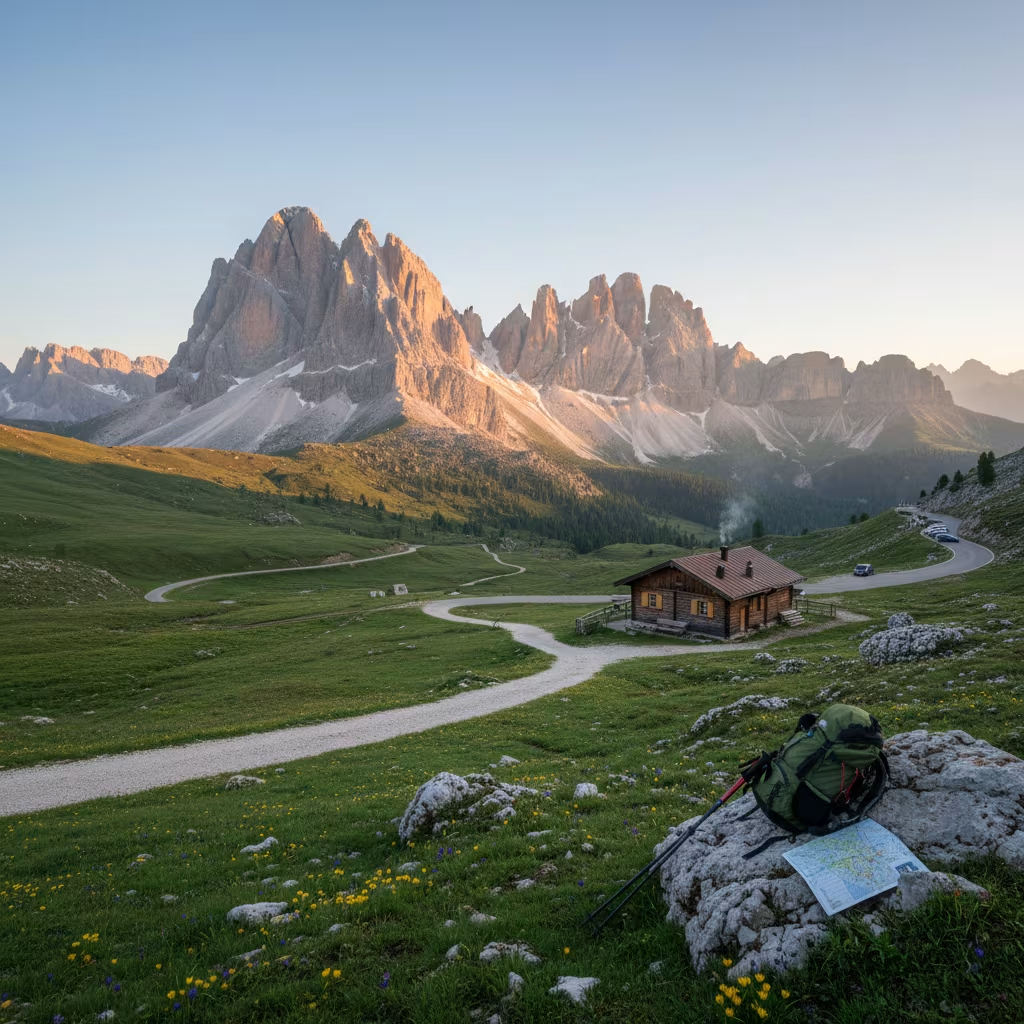
Seven days from Bolzano into Val Gardena
Day 1 Arrive in Bolzano, drive to Ortisei. Bolzano (Bozen) is the natural gateway, well-connected by train from Innsbruck, Verona, and Milan, and a good first-night city in its own right. Walk the main street (Piazza Walther), visit the South Tyrol Museum of Archaeology (home to Ötzi the Iceman), and eat dinner at Hopfen & Co, where the food is definitively South Tyrolean rather than Italian. Next morning, rent a car from the Bolzano station and drive 45 minutes up the Val Gardena to Ortisei, your base for the first half of the week.
Day 2 Alpe di Siusi plateau. The Seiser Alm (Alpe di Siusi in Italian) is the largest high-altitude alpine meadow in Europe, a 56 square kilometer plateau at 1,800–2,350m above the Val Gardena. Take the gondola from Ortisei (€15 return, runs from late May) to the plateau and walk the easy 8km circuit to Compatsch and back along the eastern edge, with the Sciliar massif behind you and the Geislerspitzen ahead. In late May, the meadows are studded with yellow globeflowers and the occasional remaining snowfield. Lunch at the Rifugio Laurin (Compatsch): schüttelbrot, speck, and a glass of Lagrein.
Day 3 Val di Funes and the Odle group. Drive 40 minutes south to Santa Maddalena in the Val di Funes, the village at the foot of the Odle group that appears in every Dolomites calendar photograph. The church of St. Johann in Ranui is the specific view, best in early morning light. Walk the circuit path from the village up through the meadows (easy, 4km, about 1.5 hours). In late May with no other hikers visible, this is transcendent. Return via Villnöss (Funes village) for lunch at one of the small agritourismo restaurants that serve local speck platters and cheese from the valley farms.
Day 4 Drive to Cortina d'Ampezzo. The drive from Ortisei to Cortina over the Passo Gardena and Passo Falzarego is itself worth the trip: the hairpin ascent to each pass and the sudden revelation of the view from the top rank among the best driving roads in the Alps. Check into Cortina and walk the Corso Italia (the main shopping street) for orientation. Dinner at Ristorante El Camineto, a 15-minute walk from the center, excellent venison and polenta, about €35/person.
Day 5 Tre Cime di Lavaredo. In late May, this is completely different from July. Drive to the Rifugio Auronzo (toll road, €25/car) by 7:30 AM and the Tre Cime circuit (9km, moderate, 3 hours) has almost nobody on it. The three limestone towers in morning light with snow still on the northern faces and a wildflower meadow at the base is the defining Dolomite view. Do it now, like this, rather than in August when it's a queue. Have lunch at Rifugio Lavaredo at the base of the towers.
Day 6 Lago di Braies and the Pragser Wildsee circuit. The impossibly turquoise lake 45 minutes northwest of Cortina. Arrive before 9 AM (the parking fills by 10, even in May) and walk the full 3.5km circuit around the lake: it takes about 1.5 hours and the color of the water changes at each vantage point. This is a place that photographs have made somewhat famous for being photogenic, and the photographs are accurate. Afternoon free in Cortina.
Day 7 Return through Bolzano. Early morning on the Dolomite Road (Strada delle Dolomiti, SS48) back toward Bolzano, stopping at Passo Pordoi for a final wide-angle view of the entire range. Return the car, afternoon train south.
Ortisei, Val di Funes or Cortina as a base
Ortisei (urtijëi in Ladin)
The Val Gardena village with the best infrastructure for the western Dolomites. The Adler Dolomiti Spa & Sport Resort is the splurge option (€280–350/night in May, prices climb in July); the Hotel Garni Florian is a comfortable family-run mid-range at €90–120/night B&B. Ortisei has excellent dining, a good weekly market, and the gondola to Seiser Alm.
Cortina d'Ampezzo
The eastern Dolomites base, glamorous in winter (it hosted the 1956 Winter Olympics and the 2026 Winter Olympics), relaxed and walkable in spring. The Cristallo Hotel Spa & Golf is the traditional grande dame at €250–400/night; the Hotel Montana is a solid mid-range at €100–150/night with reliable views. Budget travelers should look at Airbnb in the surrounding villages (Pocol, Fiames) at €70–100/night.
Rifugi
For one night in a mountain hut, Rifugio Lagazuoi (atop the cable car above Passo Falzarego) is extraordinary: €75–95/person half-board, 360-degree views of the range at sunset and sunrise. Book months ahead for summer; in late May you may get a spot with a week's notice.
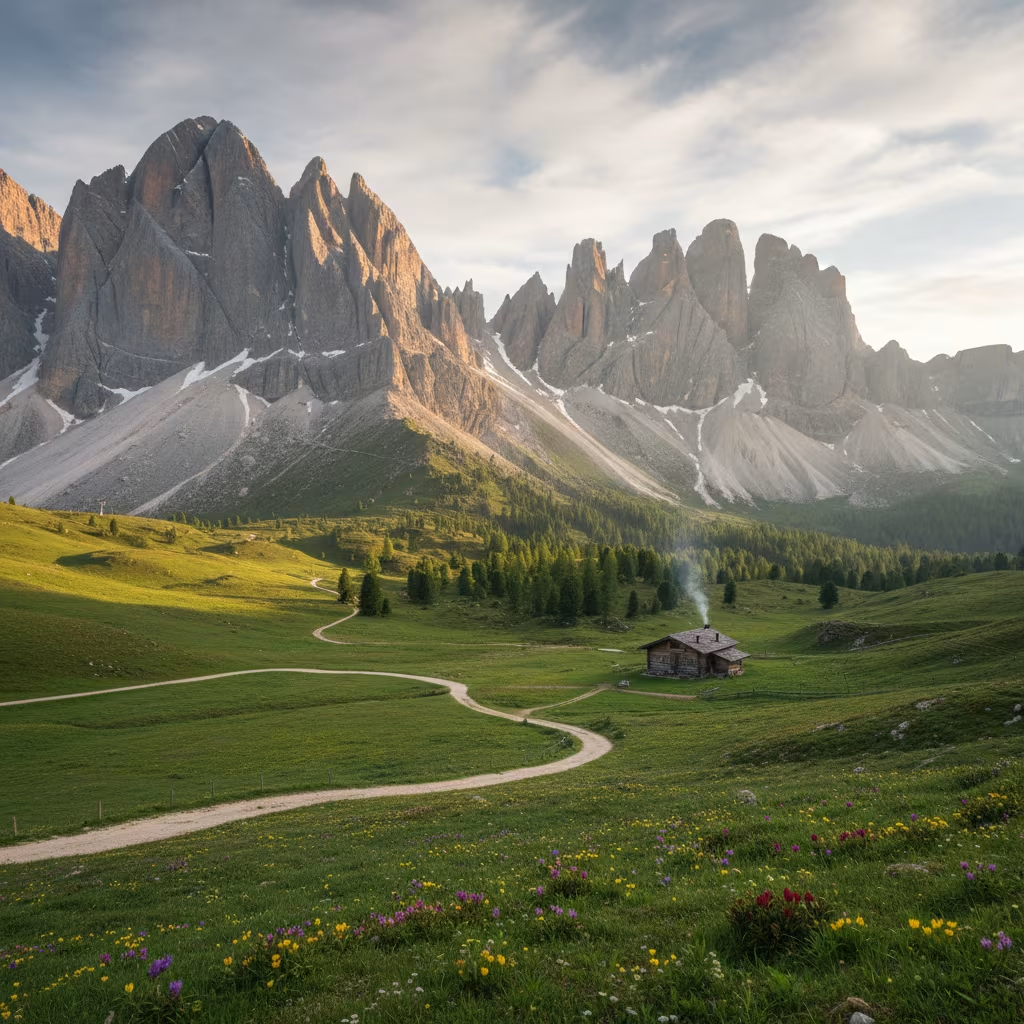
Innsbruck or Verona — and why you need a car
The closest major airports are Innsbruck (1.5 hours to Bolzano by train) and Verona (2 hours). Venice Marco Polo also works at 2.5–3 hours. Fly into whichever is cheapest.
A car is strongly advisable in the Dolomites: the passes and the rifugio access roads are either not served by public transport or served by slow, infrequent buses. Rent from Bolzano train station. The Val Gardena and Alta Badia areas have good public bus networks within the valley; the Cortina area is more dependent on cars.
Local driving note: the Passo Gardena, Passo Pordoi, and Passo Falzarego are closed in winter and typically reopen in May (check current status at dolomiti.org). Roads can be snowy at pass summits in late May, so carry tyre chains or check the conditions before driving.
Late May to mid-June: the window this guide is built on
Late May to mid-June
The optimal window for the strategy described in this guide. Snow cleared from low trails, wildflowers at peak, minimal crowds, slightly reduced rifugio hours but largely open. Temperatures 10–18°C in valleys, colder at altitude. Pack layers.
July to mid-August
Peak season. Spectacular weather, all facilities open, all trails accessible. Also peak crowds: parking is a daily problem at famous viewpoints, accommodation books months ahead, rifugio queues at lunch. Worth it if you can't come at other times; plan to arrive early at every viewpoint.
September to mid-October
Second-best window. Quieter than summer, larch forests turning gold (late September–October), harvest season in the valleys, all facilities still open. Temperatures dropping (7–15°C in valleys). The last two weeks of September may be the single best time in the Dolomites, by most experienced visitors' reckoning.
November to April
Ski season in the resort villages, closed or limited access to hiking trails, rifugi closed. Completely different experience, essentially a different destination.
Dolomites questions that come up every spring
Visitors to the Dolomites consistently ask the same practical questions.
Do I need hiking poles?
For the routes described above (all rated easy to moderate), poles are not required. They're helpful on any significant descent. If you have them, bring them; if you don't, don't buy them for this specific itinerary.
Is altitude sickness a concern?
The Dolomites are high but not extreme: most passes and rifugi are at 2,000–2,700m. Mild altitude effects (headache, reduced energy) are possible if you ascend quickly from sea level. Acclimatize for one day before your first strenuous hike and drink more water than you think you need.
What language is spoken?
Three, actually: Italian, German, and Ladin (a Romance language local to the Dolomite valleys). In South Tyrol (Trentino-Alto Adige), German is the primary language of most locals and German or English is more reliably understood than Italian in the smaller villages. In Cortina, Italian is primary. English is widely understood in tourist-facing businesses throughout.
How do I book rifugi in advance?
Most rifugi have websites (easily found by name in Italian) with email bookings; some use phone reservations only. Book at least four to six weeks ahead for summer; in late May, one to two weeks is usually sufficient. Half-board (dinner, bed, breakfast) is the standard offering and is almost always the best value: expect €65–95/person.
Dolomites logistics:
| Item | Figure |
|---|---|
| Season trick | May / September — or 5 AM light |
| Bolzano → Ortisei | 45 minutes by rental car |
| Seiser Alm | 56 km² plateau at 1,800–2,350 m; gondola €15 return |
| Alpe di Siusi circuit | easy 8 km |
| Val di Funes circuit | 4 km, ~1.5 hours |
0 Comments
No comments yet — start the conversation.