


The multi-city European trip is the most-common first-international-trip itinerary. London + Paris + Rome in 10 days; Amsterdam + Berlin + Prague in 8 days; Barcelona + Madrid + Lisbon in 12 days. The format works — when planned with realistic logistics + pacing.
The rookie mistake: 7 cities in 14 days. The result is 6 transit days + 8 tourist-mode days + zero memorable depth.
This is a 2026 field guide for planning multi-city European trips. The advice covers the 'right' number of cities, pacing, transit logistics, country combinations, and what to optimize.
How Many Cities?
The Math
For European city trips:
- Travel day between cities consumes 4-8 hours of useful time (transit + check-out + check-in).
- Each city minimum for genuine engagement: 2 full days + 2 partial days (3 nights minimum).
- 3 nights per city = real experience; 2 nights = compressed; 1 night = transit, not visit.
Recommended City Count by Trip Length
| Trip length | Maximum cities | Recommended |
|---|---|---|
| 7 days | 2 cities | 1-2 cities |
| 10 days | 3 cities | 2-3 cities |
| 14 days | 4 cities | 3-4 cities |
| 21 days | 5 cities | 4 cities |
| 30 days | 6-7 cities | 5-6 cities |
If you're planning more cities than this, you're planning for transit + photos, not experience.
Country Combinations That Work
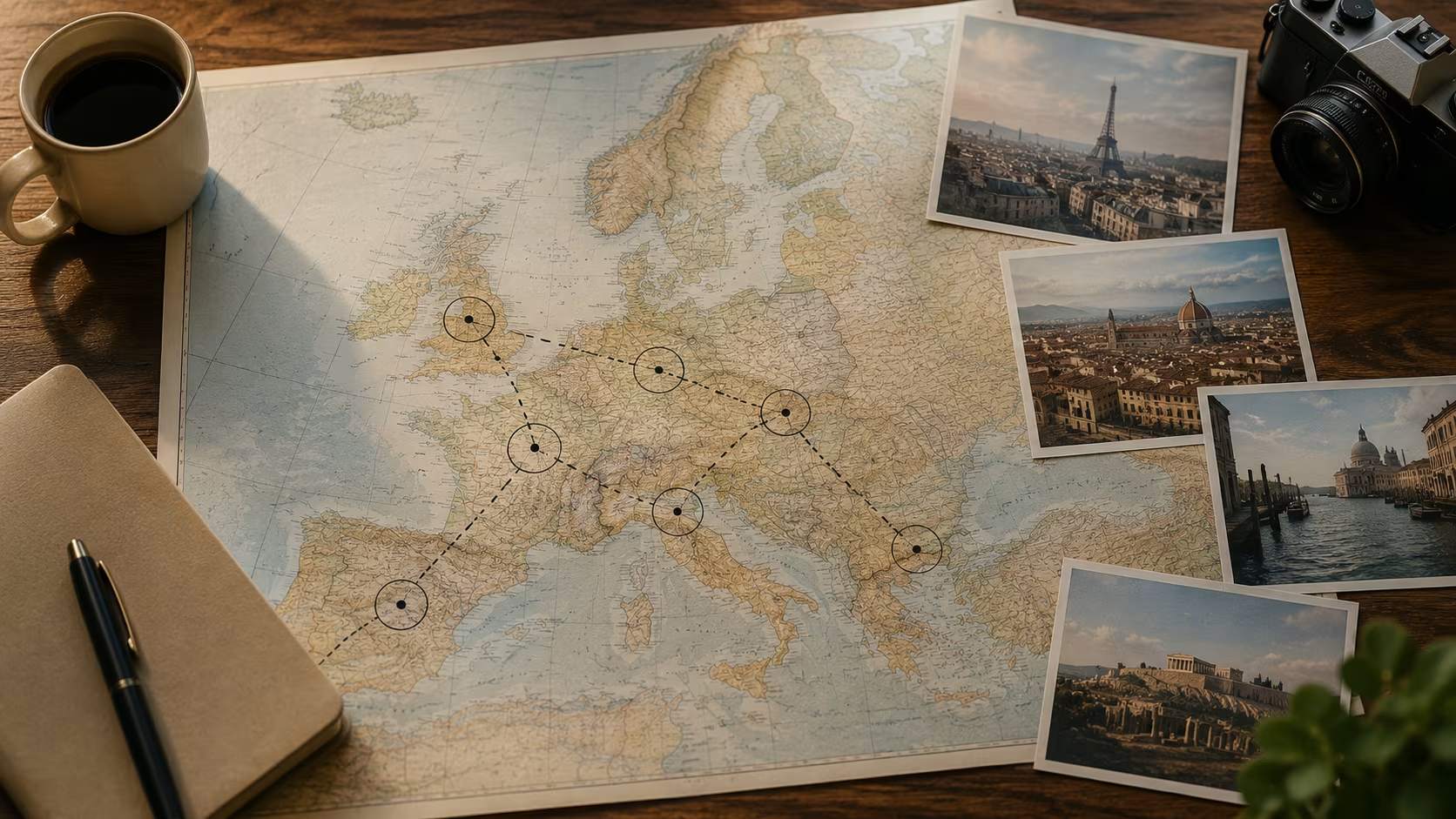
Group destinations geographically to minimize transit:
UK + Ireland
- London + Edinburgh (3+3+2 days = 8 days). Train: 4h 30m by LNER.
- London + Paris + Amsterdam (Eurostar from London) — international focus.
- Dublin + Edinburgh (1h flight).
France + Mediterranean
- Paris + Provence + Côte d'Azur.
- Paris + Bordeaux + Nice.
- Paris alone + day trips for first-time visitors.
Italy
- Rome + Florence + Venice (the classic). Train: Rome → Florence (90 min); Florence → Venice (2h 5m).
- Rome + Florence + Tuscan countryside (slow alternative).
- Rome + Florence + Amalfi Coast (city + coast).
- Italy + Sicily (different trip; ferry + flight required).
Spain + Portugal
- Madrid + Barcelona + Lisbon. AVE between Madrid + Barcelona (2h 30m); flight Barcelona → Lisbon (1h 30m).
- Madrid + Andalusia (Granada + Seville + Córdoba) + Barcelona.
- Lisbon + Porto (slower variant).
Central Europe
- Vienna + Budapest + Prague (the classic). Trains.
- Berlin + Vienna + Prague (different geographic order).
- Berlin + Prague + Krakow (north German + Polish heritage).
Scandinavia
- Copenhagen + Stockholm + Oslo. Flights + ferries.
- Copenhagen + Stockholm (overnight ferry + 2 cities).
- Helsinki + Stockholm + Tallinn (ferry-based combinations).
Iberian + Mediterranean
- Lisbon + Madrid + Barcelona.
- Marrakech + Lisbon + Madrid (international).
Nordic / Baltic
- Tallinn + Riga + Vilnius (the Baltic capitals).
- Helsinki + Stockholm + Copenhagen.
Eastern European
- Prague + Budapest + Vienna.
- Krakow + Warsaw + Berlin.
- Sofia + Belgrade + Bucharest.
The 'Right' Pace
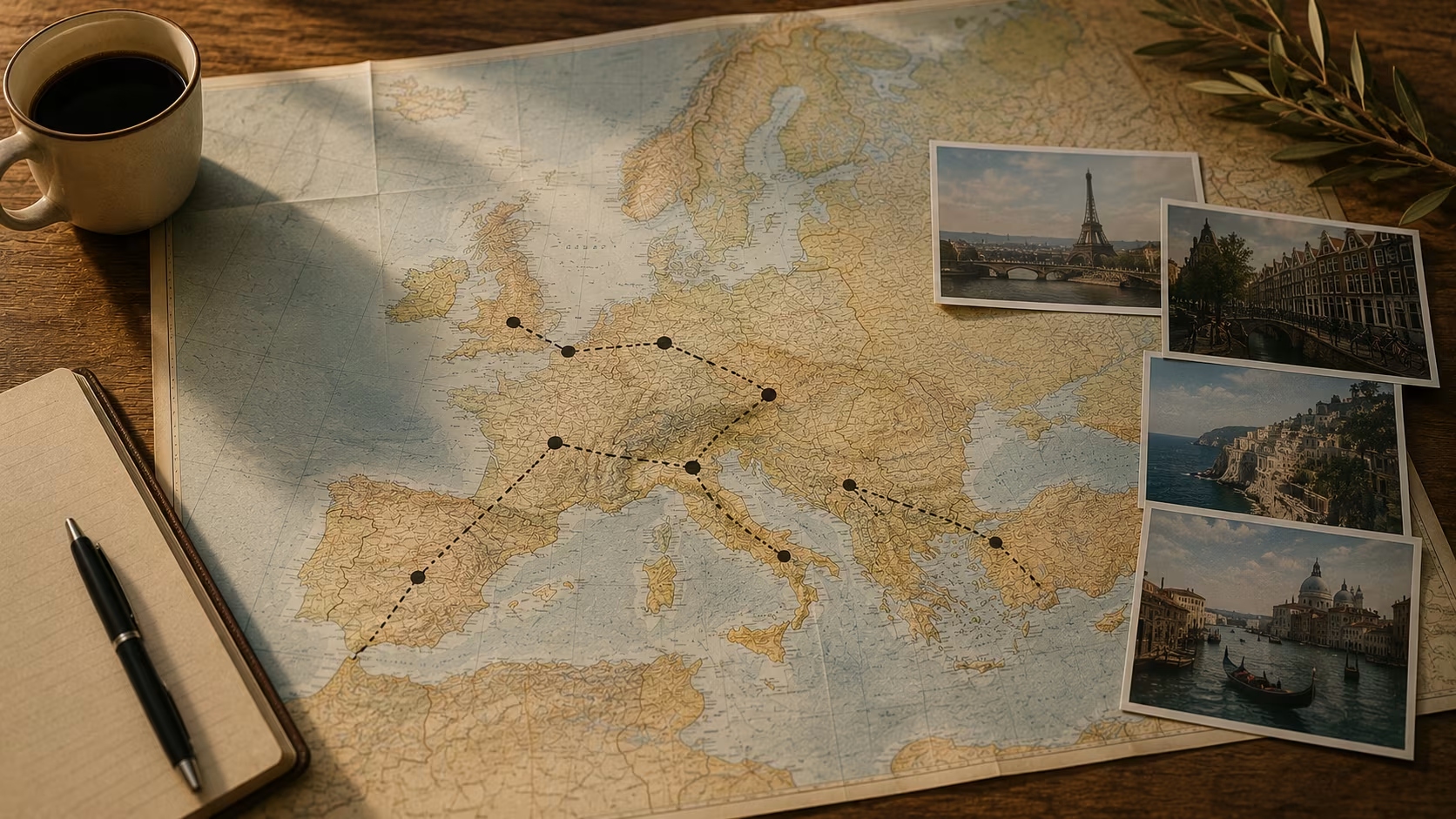
Per-City Time Allocation
For 3-night/4-day stops:
- Day 1 (Arrival). Light sightseeing; orient; eat; early bed.
- Day 2. Major morning activity + lunch + afternoon activity.
- Day 3. Slower; second-tier sites; morning tour or walk; afternoon free.
- Day 4 (Travel Day). Departure to next city.
Per-City Time Allocation (4-night Variant)
- Day 1. Arrival + light.
- Day 2. Major sites.
- Day 3. Day trip (Tuscany from Florence; Sintra from Lisbon; Versailles from Paris).
- Day 4. Slow morning + departure.
Multi-Sight Cities: 4 Nights Minimum
London, Paris, Rome, Berlin, Madrid, Barcelona, Vienna deserve 4+ nights. Trying to fit them in 2 produces frustration.
Smaller Cities: 2-3 Nights
Florence, Edinburgh, Salzburg, Granada, Lisbon, Porto, Prague, Krakow, Bruges, Helsinki — 2-3 nights typically suffices for first-time visitors.
Day-Trip Cities: 1 Night Maximum
Verona, Salamanca, Segovia, Bath, York — half-day or 1 overnight is enough.
Transit Logistics
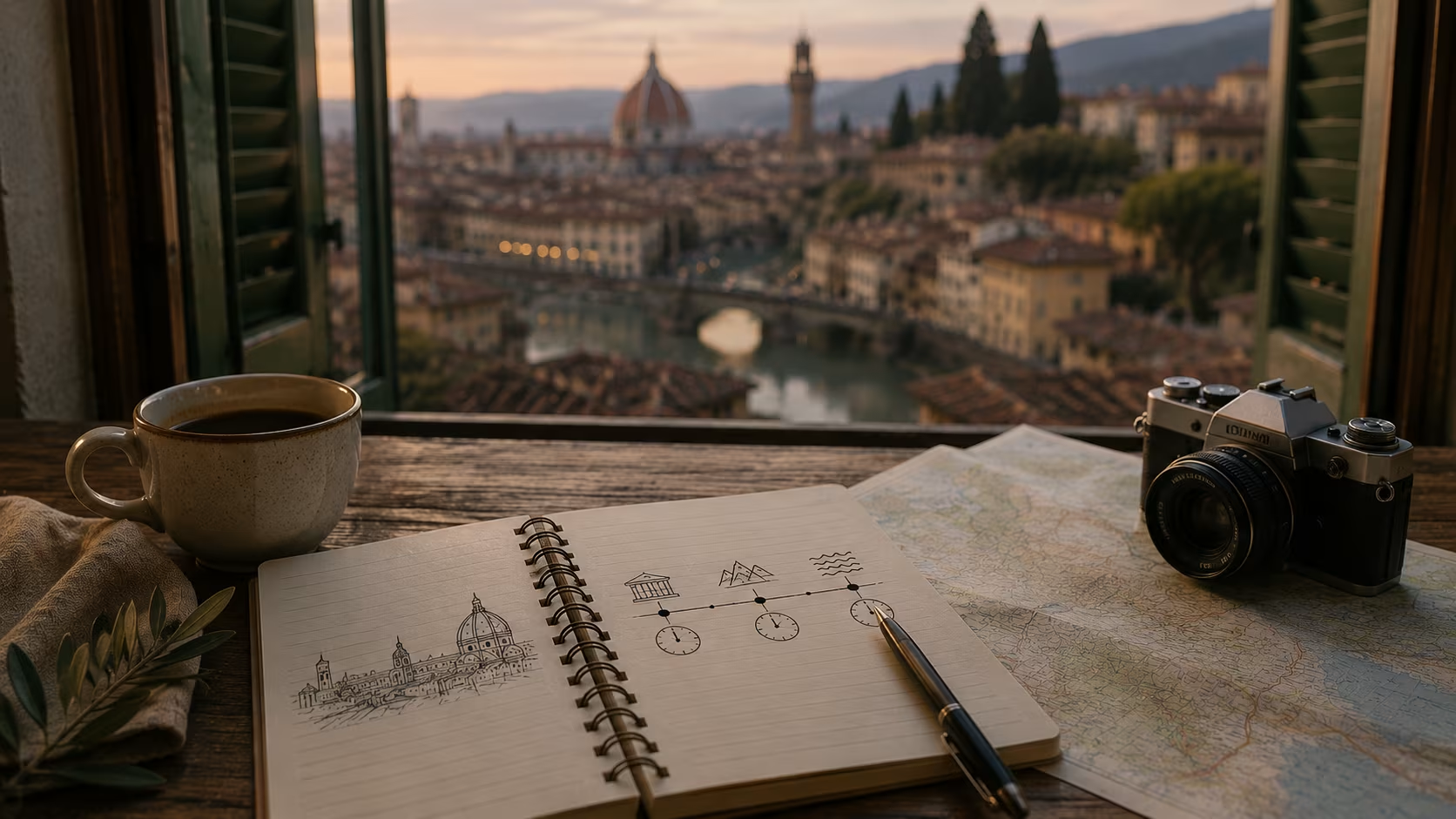
Train > Plane Within Europe
For most intra-European travel:
| Route | Train | Plane | Better |
|---|---|---|---|
| Paris → London (Eurostar) | 2h 20m | 90m + 3h airport | Train |
| Paris → Brussels | 1h 22m | n/a | Train |
| Paris → Amsterdam (Thalys) | 3h 20m | 90m + 3h airport | Train |
| Madrid → Barcelona (AVE) | 2h 30m | 90m + 3h airport | Train |
| Madrid → Seville | 2h 30m | 90m + 3h airport | Train |
| Florence → Rome | 1h 30m | n/a | Train |
| Florence → Venice | 2h 5m | n/a | Train |
| Berlin → Munich | 4h | 75m + 3h airport | Tied |
| Berlin → Prague | 4h | 70m + 3h airport | Train |
| Berlin → Vienna | 8h (overnight) | 80m + 3h airport | Plane |
| Stockholm → Copenhagen | 5h | 70m + 3h airport | Plane |
Booking Trains
- Trainline.com + Omio.com for booking + comparing across European rail networks.
- National rail websites (Trenitalia, SNCF, Deutsche Bahn, Renfe, etc.) often cheaper if you can navigate.
- Book 2-4 weeks ahead for best fares.
- First class typically 30-60% more; only worth it for very long journeys.
Booking Flights Within Europe
- Skyscanner + Google Flights for best fares.
- Budget carriers: Ryanair, EasyJet, Wizz Air. Cheap but charge for everything (carry-on, check-in, etc.).
- Major carriers: Lufthansa, Air France, KLM, Iberia. Higher base fare but checked bag often included.
- Connecting flights via Frankfurt, Munich, Vienna, Madrid sometimes cheaper than direct.
Open-Jaw vs. Round-Trip Flights
- Round-trip from same airport: simplest; cheapest typically.
- Open-jaw (different exit airport): sometimes cheaper for multi-city European trips.
- "Multi-city" search on Google Flights handles open-jaw.
Example: Fly into London + out of Rome saves the cost of returning to London first.
Specific Multi-City Itineraries
7-Day Italy: Rome + Florence + Venice
- Days 1-3: Rome (3 nights).
- Day 4: Travel to Florence (90 min train); afternoon Florence.
- Days 5-6: Florence (2 full days).
- Day 7: Travel to Venice morning (2h train); afternoon + evening Venice.
- Day 8: Final morning Venice; depart from Venice.
This is technically a 7+1 day trip. For a true 7-day version, drop one city.
10-Day Iberian: Madrid + Barcelona + Lisbon
- Days 1-3: Madrid (3 nights).
- Day 4: Travel to Barcelona (AVE, 2h 30m); afternoon.
- Days 5-6: Barcelona (2 full days).
- Day 7: Travel to Lisbon (flight, 90m).
- Days 8-9: Lisbon (2 full days).
- Day 10: Final morning Lisbon; depart.
14-Day Central Europe: Vienna + Budapest + Prague
- Days 1-3: Vienna (3 nights).
- Day 4: Travel to Budapest (train, 3h).
- Days 5-7: Budapest (3 full days).
- Day 8: Travel to Prague (train, 7h, scenic).
- Days 9-12: Prague (4 nights).
- Day 13: Travel back to Vienna (train, 4.5h).
- Day 14: Vienna day; depart.
14-Day Scandinavia: Copenhagen + Stockholm + Oslo
- Days 1-4: Copenhagen (4 nights).
- Day 5: Overnight ferry Copenhagen → Oslo or fly.
- Days 6-9: Oslo (4 nights).
- Day 10: Train Oslo → Stockholm (4h 30m, scenic).
- Days 11-13: Stockholm (3 full days).
- Day 14: Stockholm departure.
21-Day Italy + France
- Days 1-4: Rome (4 nights).
- Day 5: Travel to Florence.
- Days 6-9: Florence (4 nights including Tuscany day trip).
- Day 10: Travel to Venice.
- Days 11-13: Venice (3 nights).
- Day 14: Fly Venice → Nice or Marseille.
- Days 15-17: French Riviera (3 nights).
- Day 18: Train Nice → Paris (5h 50m by TGV).
- Days 19-20: Paris (2 nights).
- Day 21: Departure.
Country Combinations to Avoid
These combinations look attractive on maps but produce excessive transit:
Italy + Greece in 10 Days
- Rome + Athens + Santorini in 10 days = 4-5 transit days. Too compressed.
- Better: Italy alone (10 days) or Greece alone (10 days).
Spain + Portugal + Morocco in 14 Days
- Madrid + Barcelona + Lisbon + Marrakech = 4-5 transit days.
- Better: Spain + Portugal (12 days) or Morocco alone (10 days).
London + Paris + Rome in 7 Days
- 3 capitals + 2 transit days = 5 days for 3 cities. Insufficient depth.
- Better: London + Paris (7 days) or Italy alone (7 days).
All of Scandinavia in 10 Days
- Copenhagen + Stockholm + Helsinki + Oslo = 4 capitals + 3-4 transit days = compressed.
- Better: 2 capitals deep dive.
Eastern Europe Capital Hop in 14 Days
- Prague + Vienna + Budapest + Bratislava + Krakow + Warsaw = 6 cities.
- Better: 3-4 cities with deeper engagement.
Budget Planning by Country
2026 daily budgets per person, excluding flights and hotel:
| Region | Budget | Mid-range | Comfortable |
|---|---|---|---|
| Eastern Europe (Prague, Krakow, Budapest) | $50-90 | $100-160 | $200-300 |
| Mediterranean (Spain, Portugal, Italy) | $70-120 | $140-220 | $280-400 |
| Central Europe (Vienna, Berlin, Munich) | $90-140 | $170-260 | $320-450 |
| Western Europe (Paris, Amsterdam, Brussels) | $100-160 | $200-320 | $380-550 |
| UK + Scandinavia | $130-190 | $250-400 | $450-650 |
Pacing Within Each City
Day 1: Arrival
- Don't try to do major sights. Travel exhaustion + jet lag.
- Light walk through neighborhood.
- Casual dinner.
- Early bed.
Day 2: Big Day
- Major activity in morning.
- Real lunch.
- Afternoon major activity.
- Aperitivo + dinner.
Day 3: Variety
- Day trip OR slower day.
- Mid-tier sights.
- Cultural experience (cooking class, walking tour, market visit).
- Final dinner.
Day 4: Slow Morning + Travel
- Slow breakfast.
- One more activity.
- Train to next city by lunch.
- Arrive with afternoon for next destination.
What to Book in Advance
2-4 Months Ahead
- Major flights.
- Train tickets for high-speed routes.
- Premium hotels in peak season.
- Restaurants at Michelin tier.
- Vatican Museums + Uffizi + Anne Frank House + Colosseum (timed-entry tickets).
4-6 Weeks Ahead
- Mid-tier hotel bookings.
- Inter-city trains.
- Smaller restaurant bookings (where applicable).
- Day-trip tours.
- Walking tours.
1-2 Weeks Ahead
- Specific museum + attraction tickets.
- Local restaurant reservations for popular places.
- Confirm travel + meet logistics.
Day Of
- Most activities can be done same-day for less-popular sites.
Specific Common Mistakes
- Adding too many cities. The biggest mistake.
- Same-day flights between cities. Wastes a full day.
- Long-distance trains booked last-minute. Walk-up fares are 2-3x advance.
- Booking hotels far from train stations. Adds transit time at every city change.
- Underestimating transit logistics. Train + airport + bag time + check-in.
- Not booking premium attractions in advance. Walk-ups don't exist for Vatican, Uffizi, Anne Frank.
- Not allowing buffer days. Strikes, flight delays, illness, exhaustion.
- Heavy packing for multi-city. Each move with heavy bag is harder.
- Trying to cover all of one country in compressed time (Italy includes 20+ regions).
- Booking only Western European cities. Eastern Europe offers similar quality at half the price.
- Not learning basic phrases for each country.
- Eating dinner at 19:00. European dinners later (20:30-22:00 typical).
Specific Country Add-Ons to Consider
From Italy
- Paris (London-Paris-Italy gateway).
- Greece (ferry from Italy or flight; warm-weather).
- France's South Coast (more expensive).
From Spain
- Portugal (close + similar but distinct).
- Morocco (1 hour ferry from south Spain).
- France (TGV from Spain to Paris + Bordeaux).
From Germany
- Czech Republic (close).
- Austria (close).
- Netherlands (close).
From France
- UK (Eurostar).
- Switzerland (TGV).
- Italy (TGV).
- Spain (flight).
Practical Logistics
Hotel Strategy for Multi-City
- Same chain across cities for loyalty + consistency (Marriott, Hilton, Hyatt).
- Mid-tier 4-star hotels comfortably balance quality + price.
- Walking distance to train station when possible.
- Strategic neighborhood for sightseeing access.
Packing for Multi-City
- Carry-on only is dramatically easier across multiple cities.
- Wheeled bag if cities have smooth surfaces (Vienna, Berlin, Madrid).
- Backpack if cobblestoned (Florence, Lisbon, Rome).
- Layered clothing for variable weather.
- Compact toiletries.
- Shoes that handle 12+ km daily walking.
Communication
- eSIM with multi-country coverage (Airalo, Holafly).
- Multi-country SIM card if traveling for weeks.
- WhatsApp + Telegram for messaging.
- Google Translate offline languages.
Money
- Wise / Revolut multi-currency cards.
- Credit card with no foreign transaction fees.
- Some Euros + cash in each country's currency.
- Two cards in different bags.
Special Multi-City Scenarios
Family Multi-City
- Slower pace (3+ days per city).
- Apartments rather than hotels for space.
- Trains over flights for easier transit with kids.
- Built-in rest days.
Solo Multi-City
- Faster pace OK for solo (no negotiation).
- Hostels for social interaction.
- Daily contact with someone at home.
Couple Multi-City
- Negotiate pace before trip.
- Solo time per partner.
- Don't make every meal a "perfect" experience.
Senior Multi-City
- Slower pace (3-4 days per city).
- Direct flights rather than connections.
- Better hotels for comfort.
- Trains over flights (less airport friction).
Final Notes
Multi-city European trips work when planned with realistic logistics + pacing. The traveler who fits 3 cities in 10 days produces better experience than the one trying 6 cities in 10 days. The discipline to subtract is the planning skill.
The single best advice pick fewer cities than you initially want to visit. Whatever number you're planning, subtract one. The deeper engagement with fewer cities produces better memories than checklist tourism across more.
The second-best prioritize train over flight for intra-European travel. Trains feel like part of the trip; flights feel like transit. The intercity rail in Europe is among the world's best — ICE, Eurostar, Thalys, AVE, Frecciarossa — and the journeys themselves become memorable.
The quietest piece of advice Europe is denser than first-time American or Asian visitors expect. The cathedral 200 km from your hotel may be worth a half-day visit; a city 600 km away may not be worth a full transit day. Once you accept that compressed multi-city trips don't work, the planning becomes about choosing which experiences to skip rather than which to add.


0 Comments
No comments yet — start the conversation.