

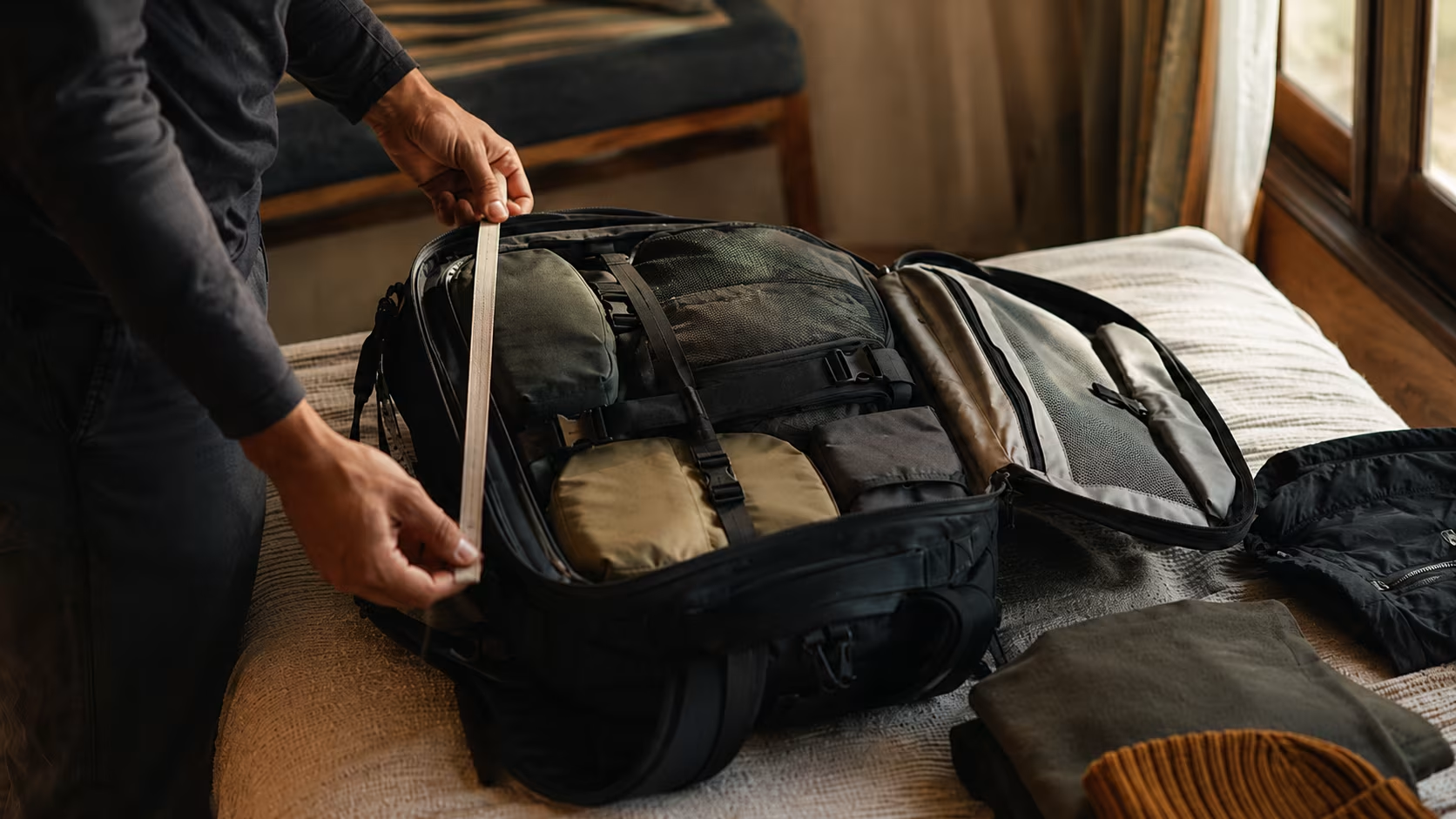
A travel backpack is the only piece of gear you'll touch every single day of every trip. Pick the wrong one and the rest of your packing strategy collapses: too small means you check a bag, too big means you blow your weight allowance, wrong opening style means you live out of a bottomless pit.
This is a buyer's framework rather than a product list. Specific products date in months; the framework lasts. The variables that actually matter, the marketing claims you can ignore, and the realistic price-to-quality curve in 2026.
The Two Decisions That Drive Everything else
Before researching brands, settle two questions.
1. Carry-on only, or check + day bag?
If you'll fly carry-on only (one or two weeks per trip, no special gear), you want a 35–45L bag that fits cabin sizers. If you check a bag (longer trips, climbing or photography gear, family travel), the main bag can be 50–70L and you need a smaller daypack as a personal item.
2. Will the bag spend more time on your back, or rolling/sitting?
- Mostly on your back, walking, hiking, public transit → backpack-first design.
- Mostly rolling on airport floors → wheeled or hybrid. Backpack straps as a backup.
This decision shapes the structure: a true backpack has a real hipbelt and frame; a hybrid has minimal padding, since 90% of the time it's on wheels.
Capacity — the Right Numbers
Backpack capacity is measured in liters, but the marketing numbers are not always honest. Real-world capacity (after stuffing) is usually 5–10% less than the listed liter rating. Think in real terms.
| Trip length | Recommended capacity | Notes |
|---|---|---|
| 2–3 days | 20–25L | Fits under most airline seats |
| 5–7 days (carry-on) | 30–40L | Fits cabin sizers if shape is right |
| 10–14 days (carry-on) | 38–45L | The sweet spot for two-week solo |
| 2–4 weeks (checked OK) | 50–65L | Larger trip, family, gear-dependent |
| Expedition / multi-month | 65–80L | True backpacking, camping, technical gear |
Most travelers over-buy. A 50L bag for a 7-day trip means you'll fill the empty space with things you don't need, then drag the weight around for a week.
Carry-On Sizing — the Inflexible Rule
If carry-on only, every airline has a maximum carry-on dimension. The smallest of those, in 2026, is 40 × 25 × 20 cm (Ryanair's free small-bag rule).
Realistic 2026 cabin baggage rules (the bag you don't pay for):
| Airline category | Max size (cm) | Weight |
|---|---|---|
| Ryanair / Wizz Air (free small) | 40 × 25 × 20 / 40 × 30 × 20 | 10 kg |
| easyJet (free small) | 45 × 36 × 20 | 15 kg |
| Lufthansa, Swiss, Air France, KLM | 55 × 40 × 23 | 8–12 kg |
| British Airways | 56 × 45 × 25 | 23 kg |
| Delta, United, American | 56 × 36 × 23 | None specified |
| Emirates, Qatar, Singapore | 55 × 38 × 20 | 7 kg |
| Turkish Airlines | 55 × 40 × 23 | 8 kg |
Design your bag selection around the smallest airline you'll fly. A 40 × 25 × 20 bag fits every other airline, even though most allow more. Going larger means buying priority boarding upgrades you didn't budget for.
Opening Style — the Most Underrated Choice
Opening style is what separates a travel backpack from a hiking pack. The four main types:
Top-Loading (Hiking-Style)
Drawstring at the top, gear stuffed down. Inefficient for travel, since you have to dig to find anything.
- Good for: actual hiking trips, multi-day trekking.
- Bad for: city travel, frequent unpacking, organization.
Clamshell (Suitcase-Style)
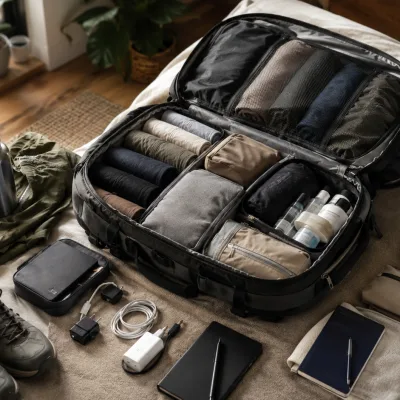
Full zip around three sides, opens flat like a suitcase. The travel-backpack standard.
- Good for: city travel, hostels, packing cubes, hotel-room living.
- Bad for: pure outdoor / wet conditions (more zipper exposure to weather).
Front-Panel
U-shaped zipper opens the front panel like a flap. Halfway between top-loading and clamshell. - Good for: hybrid trips, frequent quick access.
Rolltop
Folds and clips at the top. Modern outdoor-meets-urban look.
- Good for: variable cargo size, casual urban travel.
- Bad for: airport efficiency (slower to access), strict size limits.
For most travel, clamshell is the answer. A 40L clamshell with a separate laptop sleeve and a few internal pockets is the baseline.
Frame and Suspension
The frame is what transfers weight from your shoulders to your hips. Underrated until you carry the wrong bag.
Frameless. No internal structure. Lightest, least supportive. Fine for under 20L; punishing over 30L.
Internal frame. Aluminum stays or composite plates. Distributes weight, holds shape. The standard for travel and hiking packs over 30L.
External frame. Mostly extinct except in expedition / military packs. Skip.
Hip belt. Below 30L, optional. Above 30L, essential. A real hip belt (padded, with structure, sized to your waist) transfers 60–70% of the pack weight off your shoulders. A token strap for fashion isn't a hip belt.
Sternum strap. Helps stabilize the load while walking; not load-bearing. Standard on most travel packs.
Materials and Construction
Fabric weight (denier, D). Higher numbers = thicker and tougher. Travel sweet spot is 400D–630D nylon or polyester. Below 400D feels flimsy after a year. Above 1000D is overkill for non-expedition use.
Cordura. A trademark of high-tenacity nylon. "Cordura 500D" is good; "500D nylon" without the brand name is variable.
Coated nylon (PU, silicone, X-Pac). Adds water resistance. Travel packs get rained on more than people expect.
Recycled materials. Most major brands now offer 100% recycled PET fabric versions. Performance is roughly equivalent to virgin nylon for travel use; environmental marketing varies in honesty.
Zippers. YKK is the industry standard; brand-name budget bags substitute cheaper SBS or unmarked zippers, which fail in 1–3 years. Inspect zipper labels before buying.
Buckles. ITW or Duraflex on quality bags. Generic plastic buckles crack in cold or heavy use.
Stitching. Bartacks (the dense reinforcement at strap attachment points) are the failure point. Look at where the shoulder straps meet the body: it should be heavily reinforced, not single-line stitched.
Fit — the Personal Variable
A bag rated for someone 1.80m tall doesn't fit a 1.60m frame the same way. Most travel packs are sold in one size; quality brands offer two or three torso lengths.
The key measurement is torso length, not height. From the bony bump at the base of your neck (C7 vertebra) down to the top of your hipbones. Most adults are between 40 and 55 cm.
| Torso length | Frame size |
|---|---|
| Under 40 cm | XS / Women's S |
| 40–46 cm | S / Women's M |
| 46–51 cm | M (most common) |
| 51–56 cm | L |
| Over 56 cm | XL |
Test it loaded. Most retailers (REI in the US, Decathlon in Europe, Snowys in Australia) will fill a bag with weighted bags so you can walk around for 10 minutes. Spend the time. A bag that feels fine empty becomes obvious in different ways at 10 kg.
Women-specific cuts. Generally narrower shoulder straps, shorter back panels, contoured hip belts. Worth looking at; some women fit better in unisex small, some specifically need women's-cut.
Features That Actually Matter
- Padded laptop sleeve (separate from main compartment, accessible from the side or top, not just the back panel).
- Hidden security zip (against the back panel, against your body when worn, for passport and main wallet).
- External water bottle pocket (mesh, accessible while walking, fits a real bottle including 1L Nalgene shape).
- Stowable straps (zip away into a panel for airline check; one of the most useful features for hybrid travel).
- Compression straps (cinch the bag to its loaded size; reduces bounce when half-empty).
- Lockable zipper pulls (two pulls that meet at a single point so you can put a TSA-approved padlock through them).
Features That Don't Matter
Marketing claims to discount:
- "Anti-theft" labeling. Hidden zippers and lockable pulls are real features. The word "anti-theft" with no specifics is marketing.
- Built-in chargers / batteries. Airlines now restrict integrated lithium-ion. Buy a separate power bank.
- "RFID-blocking" pockets. RFID skimming is largely solved at the card-issuer level since 2018. Marketing remnant.
- "Waterproof" without IPX rating. Most travel packs are water-resistant, not waterproof. A separate rain cover is more honest.
- Massive expandability flaps. Adding 15L of fabric to a 35L bag means you'll over-pack and exceed cabin sizes.
Realistic 2026 Price Curve
| Price tier | Quality expectation | Lifetime |
|---|---|---|
| Under $80 | Cheap fabric, weak zippers, no hip belt | 1–2 trips before failure |
| $80–150 | Decent for occasional use, weak straps | 2–4 years light use |
| $150–250 | The sweet spot for most travelers | 5–10 years |
| $250–400 | Premium fabrics, lifetime warranties | 10+ years |
| Over $400 | Specialist gear or marketing premium | Marketing matters more than performance |
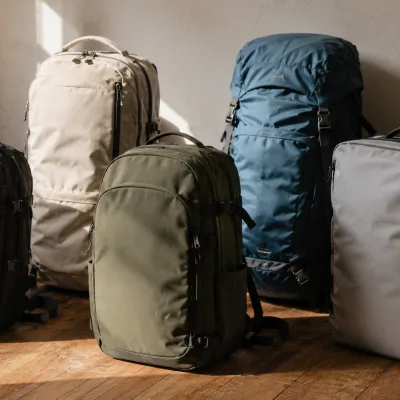
The single best price-to-quality ratio in 2026 is in the $150–250 tier. Brands consistently good at this band: Osprey (specifically the Farpoint/Fairview, Porter, and Stratos lines), Tortuga, Cotopaxi (Allpa series), Peak Design (Travel Backpack 45L), Patagonia (Black Hole pack), Aer (Travel Pack 3), Tom Bihn (Aeronaut series, premium-tier), and Decathlon's Forclaz line for budget without falling apart.
Lifetime warranties to take seriously: Osprey, Tom Bihn, Patagonia. "Lifetime warranty" from less-established brands sometimes means "of the company," which can be 6 months in practice.
How to Test a Bag You Just Bought
Before the trip, do this:
- Pack it for the actual trip. Real clothes, real toiletries, real shoes. Don't estimate.
- Weigh it. Bathroom scale; subtract your own weight while holding the bag. Aim for under 9 kg loaded for two-week carry-on travel.
- Walk for 30 minutes loaded. Stairs, sidewalks, a real city walk. Hot spots show up by minute 20.
- Drop-test the airline sizer. Most airports have a metal carry-on cage at check-in. Find one and force the loaded bag in. If it bulges, you'll fail.
- Sit with it on your back in a chair. A backpack you can't sit with at a café is wrong for travel.
Return it within the window if any of these fail. Don't optimize on the trip; you'll be too distracted.
When to Choose Wheeled or Hybrid
A pure backpack is the right answer for most travel under 14 days. A hybrid or wheeled bag becomes valid when:
- You have a back or shoulder injury (real reason to roll).
- 80%+ of your travel is between airports, taxis, and hotels with elevators.
- You travel with a laptop bag and a child and a stroller and a roller is the only way you fit through a terminal.
- You move between cities every 2 days; daily packing benefits from wheeled efficiency.
For multi-week trips with cobblestones, public transit, and stairs, a backpack still wins. Wheels turn into a problem at every step you didn't plan for.
Common Mistakes
- Buying a 60L bag for two-week carry-on. It won't fit cabin sizers; you'll over-pack the empty space.
- Skipping the load test. Empty backpacks all feel the same.
- Choosing fashion over fit. A bag that looks great in product photos can be wrong for your back.
- Ignoring the laptop sleeve placement. Laptops near the back panel hit your spine; outer-edge sleeves bounce.
- Skipping the hip belt evaluation. A token belt is worse than no belt: it implies support that isn't there.
- Buying based on Amazon reviews alone. Reviews skew toward initial impressions; the failure modes appear at month 18.
Final Notes
A travel backpack lasts five to ten years if you buy in the right tier, fits your body and your trip type, and earns its space every day. The wrong one ruins the daily rhythm of a trip and gets retired to a closet at year three.
The honest pitch: spend the $200. Once. Then ignore travel-bag marketing for the next five years. The right bag becomes invisible: you stop thinking about it, which is exactly what you want from a piece of gear that lives on your back across continents.
0 Comments
No comments yet — start the conversation.