
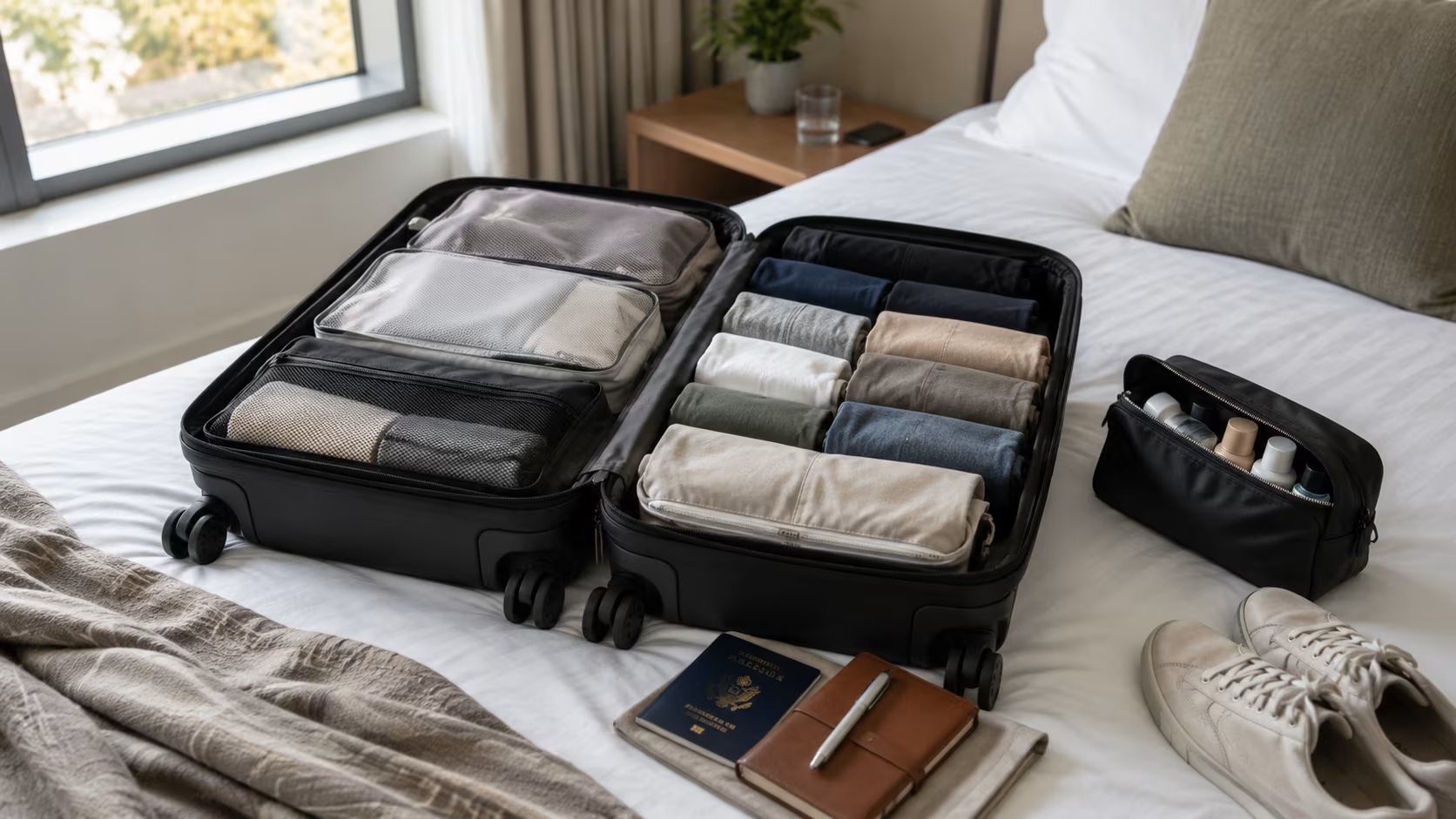
Flying carry-on only for two weeks isn't extreme minimalism. It's a system. The travelers who do this consistently aren't carrying half what other travelers carry: they're carrying the right things and rotating them. The framework is the same If you're going Lisbon, Tokyo, or Buenos Aires: pick clothes that work in layers, do laundry once mid-trip, and leave behind the items that exist mostly to fight "what if" scenarios.
This is a 2026 guide that's actually been packed and field-tested. The headline claim (fitting two weeks in a carry-on) is true. The trade-offs are also real and worth being honest about.
Why This Matters
Before the how, the why. Carry-on only saves you:
- 45–90 minutes at every airport (no checked-bag wait).
- $60–200+ per round trip in checked-bag fees on most international carriers.
- The mental friction of moving through security with multiple bags.
- Lost-luggage risk entirely.
- The temptation to overpack: a carry-on physically caps how much you can bring.
The trade-off is real: you'll wash clothes once mid-trip, you'll wear the same shirts more times than at home, and you'll skip some "just in case" items.
The Bag
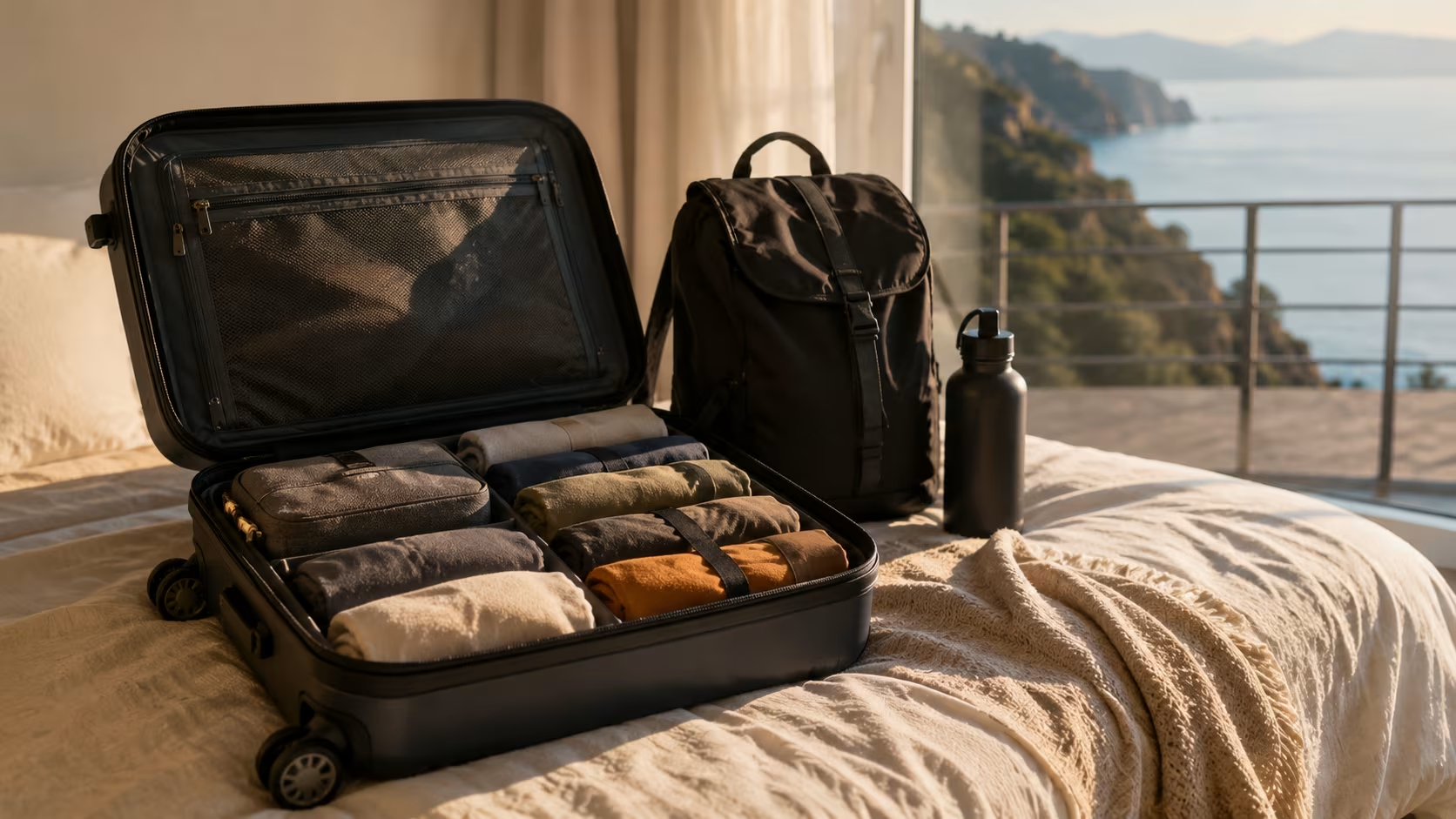
The single most important piece of gear. International carry-on dimensions vary by airline, but the safest sizes for global travel:
- Linear total: 115 cm (US carriers, most European)
- Most European budget carriers: 55 × 40 × 20–23 cm cabin bag
- Asian carriers: typically same as European
- Personal item: under-seat bag (usually 40 × 30 × 20 cm)
Buy bags labeled "international carry-on": these are sized to fit the most restrictive airlines. The slightly-larger US-only carry-ons get checked at the gate on European budget flights.
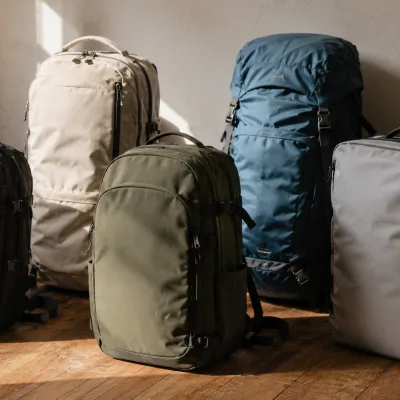
Backpack Vs. Roller
| Type | Pros | Cons |
|---|---|---|
| Backpack | Hands-free, stairs and cobblestones easy | Hot and sweaty in summer, awkward for business meetings |
| Hardshell roller | Dignified, easy to wheel, splits open for packing | Stairs, cobblestones, gravel are work |
| Soft-sided roller | Lighter, slight expansion if needed | Less protective for fragile items |
| Hybrid (convertible) | Wheels + straps; most flexible | Heavier than either pure type |
For European cobblestones + multi-stop trips travel backpack (Tortuga, Osprey Farpoint, Cotopaxi).
For business + city-only hardshell roller (Away, Travelpro, Rimowa).
For mixed-use hybrid like Osprey Farpoint Wheels.
The Personal Item
Most airlines also allow one personal item (under-seat bag). Use this for:
- Laptop / tablet
- Toiletries that don't fit elsewhere
- A change of clothes for delays
- Snacks and water bottle
- Books / cables / documents
A daypack (~20L) doubles as a personal item on the plane and a daily walking bag at destination.
The Clothing System
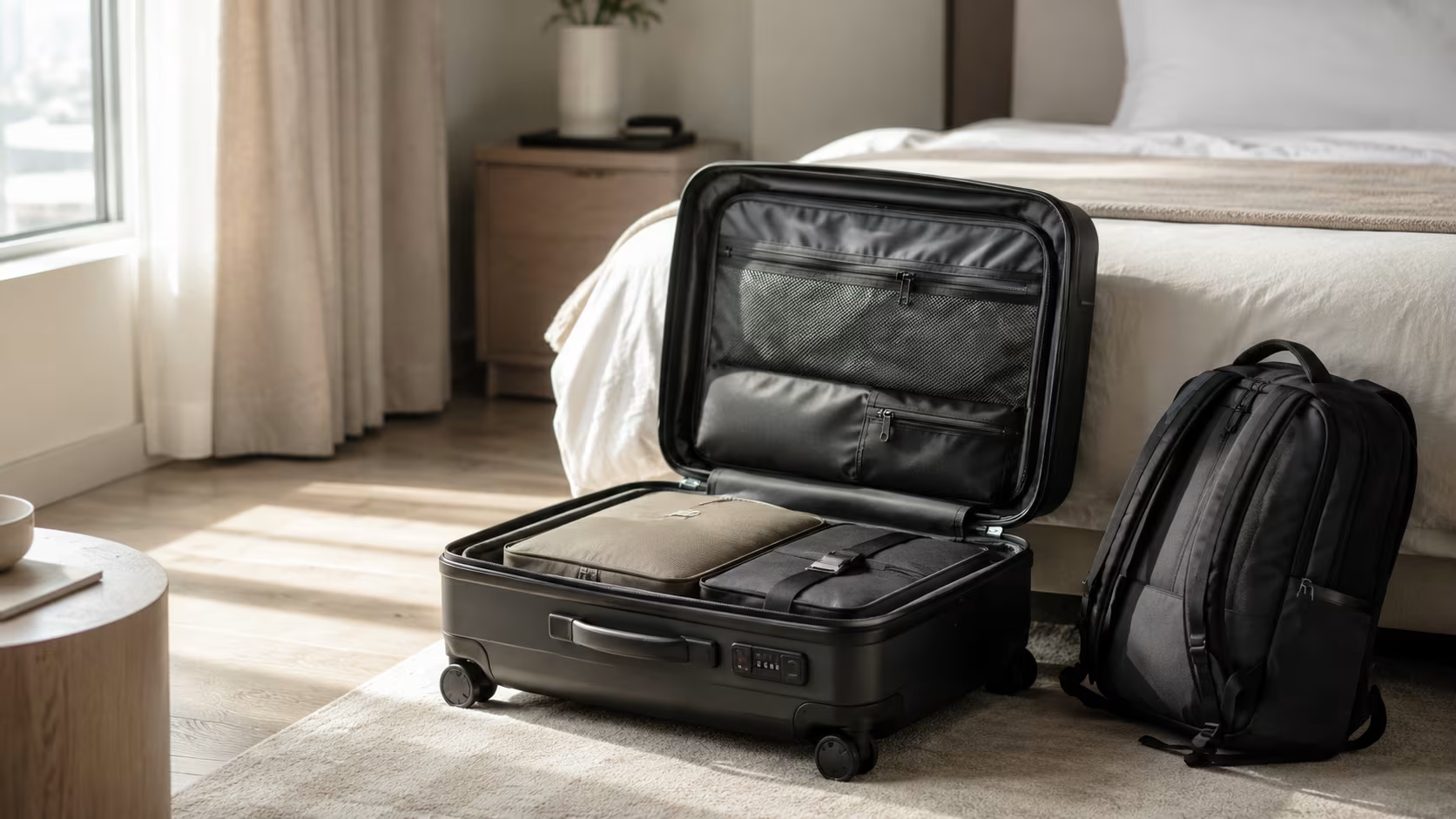
The single most important framework: everything works with everything else.
If each shirt only matches one pair of pants, you've packed three rigid outfits. If each shirt matches every pant, you've packed nine outfits using the same items.
The 5-4-3-2-1 Formula
A reliable starting point:
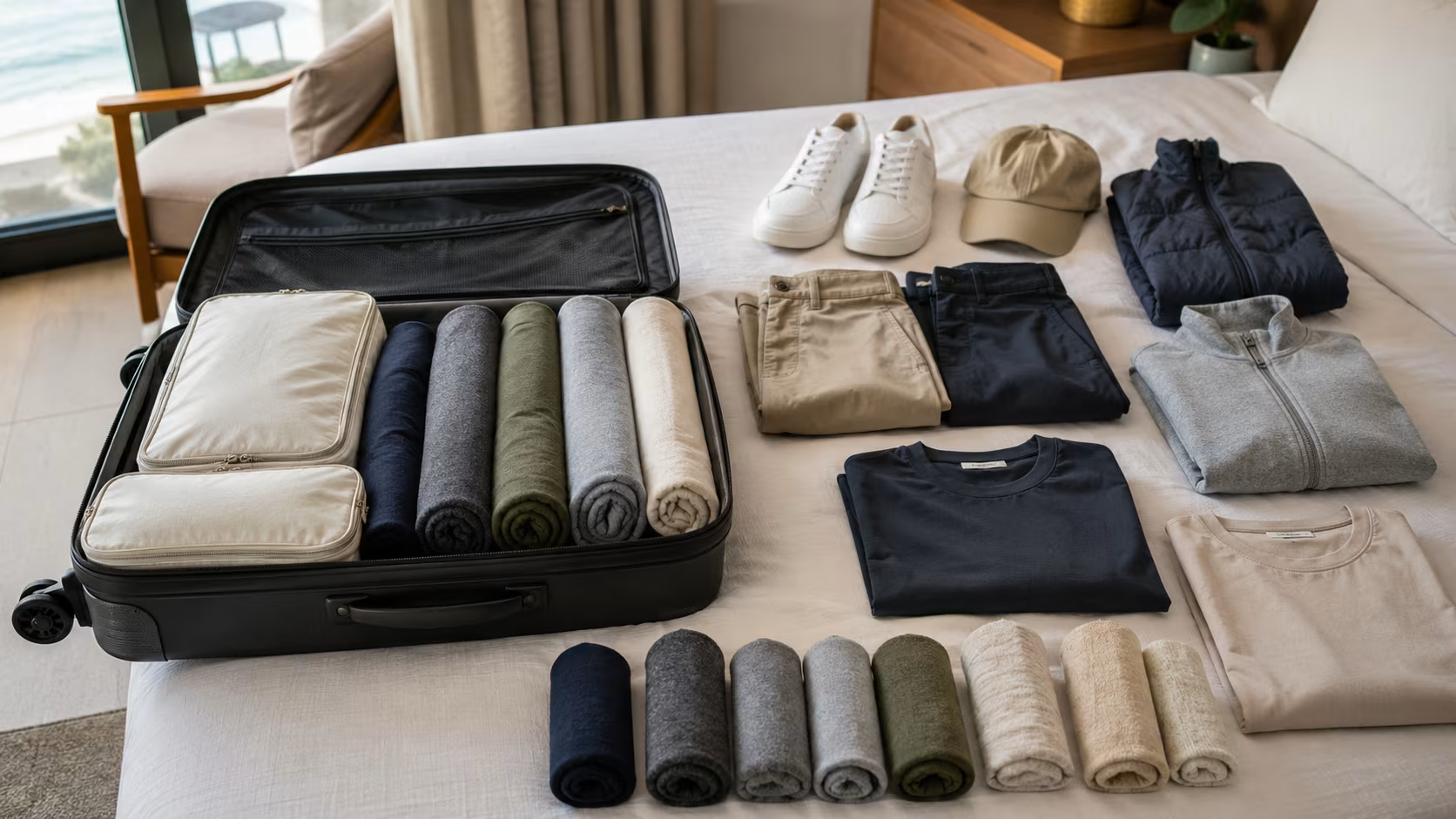
- 5 tops (3 t-shirts + 2 long-sleeve or button-up)
- 4 bottoms (2 pants + 1 shorts + 1 swim/active)
- 3 footwear (walking shoes + sandals + 1 dressier option); actually 2 if dressier isn't needed
- 2 outerwear (1 light jacket + 1 rain layer)
- 1 "one nicer" outfit for unexpected dinners or events
Plus underwear/socks (7 days; rotate twice via laundry).
Color Palette
Pick a 2-color palette plus one accent:
- Pants: dark blue + black (or navy + olive)
- Tops: white + gray + accent color (one shirt in burgundy, dark green, etc.)
- Outerwear: neutral (navy, black, charcoal)
The palette ensures everything coordinates. Save the patterns + statement pieces for weekend trips, not 14-day journeys.
Fabric Choices
For 2-week travel, prioritize:
- Merino wool. Doesn't smell, dries fast, regulates temperature. The travel fabric. T-shirts, button-ups, sweaters. Brands: Icebreaker, Smartwool, Outdoor Research, Wool & Prince.
- Synthetic blends (polyester, nylon). Quick-dry, lightweight. Active wear, swim, some travel pants.
- Travel-specific fabrics (Outlier, Bluffworks, Western Rise). Look like normal clothes, perform like sportswear.
Skip:
- Cotton-only items for daily wear (slow to dry, hold odor longer).
- Heavy denim (slow to dry, weighs the bag down).
- Linen for cold-weather trips (wrinkles, low warmth).
Specific Items: What to Bring
Tops (5 Items)
- 3 merino t-shirts (1 white, 1 gray, 1 accent color). Each weighs 150–200g.
- 1 long-sleeve henley or button-up (merino if cool destination).
- 1 collared shirt (button-up, can dress up or down).
Bottoms (4 Items)
- 1 pair travel pants (dark, multi-pocket; brands: Outlier Slim Dungarees, Bluffworks Gramercy, Lululemon ABC).
- 1 pair lighter pants or chinos (versatile color, can be dressed up or down).
- 1 pair shorts (in summer/warm climate; skip if cold).
- 1 swim/active short (doubles as athletic wear; skip if no pool/beach).
Footwear (2–3 Items)
- Walking shoes. Closed-toe; comfortable; can do 15 km daily without blisters. Brands: Allbirds Wool Runners, Nike Free Run, Asics Walking, Hoka.
- Sandals. Hot weather, beach, hostel showers. Brands: Birkenstock, Teva.
- Dressier option (skip if not needed): leather sneakers (e.g., Common Projects, Greats Royales) or low boots.
Wear the heaviest pair on the plane.
Outerwear (2 Items)
- Light jacket. A merino or synthetic mid-layer.
- Rain layer. Foldable, packable rain shell. Brands: Patagonia Houdini, Arc'teryx Beta, Outdoor Research Helium.
Underwear / Socks (7 Days)
- 7 pairs underwear. Merino or synthetic. Cotton dries too slowly for daily wash.
- 5–7 pairs socks. Merino. Crew + ankle.
- 2 bras (for women): sports bra + standard.
Sleep / Lounge
- 1 set of sleep clothes. Light merino or cotton.
One Nicer Outfit (optional)
If the trip might include a nice dinner or business event:
- 1 collared shirt (already counted above)
- 1 pair chinos or dark pants (already counted)
- 1 pair leather sneakers or low boots (counted above)
The "one nicer outfit" emerges from the system, not from extra items.
Toiletries
TSA + most international rules: liquids ≤ 100 mL each, fitting in a 1-quart (1-liter) clear bag.
Essentials
- Toothbrush + travel toothpaste.
- Deodorant (solid sticks travel better than gels; not always considered liquid).
- Soap or shower gel (60–100 mL).
- Shampoo + conditioner (60–100 mL each, or shampoo bar).
- Sunscreen (60–100 mL).
- Razor + blades.
- Floss (small dispenser).
- Skincare basics (moisturizer, lip balm).
- Prescription medications. In original bottles with prescription label.
Optional
- Hair gel / wax (small).
- Lotion / cream (small).
- Perfume / cologne (small atomizer; many available in travel sizes).
What to Leave Home
- Full-size toiletries. Buy small or use hotel amenities.
- Hair dryer. Hotels have them.
- Bath towels. Same.
- Iron. Most clothes you should travel with don't need ironing.
- Spare toothbrushes / soaps. Buy at destination if needed.
Tech (already Lean)
From previous packing wisdom: phone, charger, power bank, universal adapter, wireless headphones, two cables. Total weight: ~1 kg.
Laptop or tablet only if you'll work; otherwise leave.
Documents
- Passport. With photo backup in cloud storage.
- Travel insurance policy info in phone notes.
- Boarding passes in Apple Wallet / Google Wallet.
- Photocopy of passport in a different bag.
- Two payment cards in different bags.
- Embassy contact in phone notes.
- Hotel/Airbnb confirmations screenshotted.
- Travel insurance card.
- Vaccination records if relevant.
Packing Cubes Vs. Compression Bags
Packing Cubes
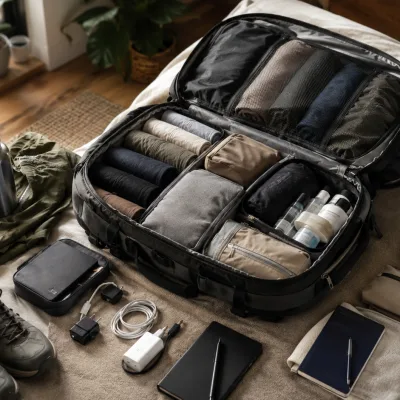
Lightweight nylon zippered bags that group clothing types. Don't compress; do organize.
Pros: find items fast; clothes stay folded; bag stays organized. Cons: add ~100g; don't reduce volume.
Compression Bags
Squeeze air out of clothing to reduce volume.
Pros fit 30–40% more clothes in same space. Cons: clothes more wrinkled; add weight; the compressed pile is hard to selectively unpack.
Best practice small packing cubes for organization; one compression bag for bulky items (jackets, sweaters) only.
The Laundry Plan
You'll do laundry once on a 14-day trip. Three options:
1. Hotel / Airbnb Laundry
Most mid-tier hotels offer laundry service ($15–40 per load). Some Airbnbs include washer/dryer.
2. Coin Laundromat
In most cities, $5–10 to wash + dry one load. 90 minutes total. The cheapest option, and the cultural-immersion bonus is real.
3. Wash-and-Fold Drop-Off
Drop laundry at a local service in the morning; pick up clean and folded in the afternoon. $8–25 per load. Common in many cities.
The plan: packed clothes for 7 days. Laundry on Day 6 or 7. Clothes available again for Days 8–14.
Summer Vs. Winter Adjustments
Summer (warm-weather Trip)
- Swap layers for shorts and tank tops.
- Skip the heavier jacket.
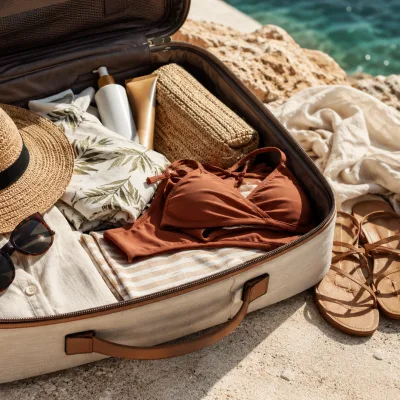
- Sun hat + sunglasses become essential.
- Sandals get more wear.
Winter (cold-weather Trip)
- Add a pack-down puffy jacket (Uniqlo Ultra Light Down or equivalent, 250–400g, fits in a stuff sack).
- Wool base layer (top + bottom) for layering.
- Thicker socks; skip shorts.
- Beanie + thin gloves.
Wearing the heaviest items on the plane (jacket, puffy, leather sneakers) saves bag space.
What to Skip Even if You Think You Need It
- Dress shoes. Leather sneakers handle most "nicer" occasions.
- Multiple pairs of jeans. One travel-pants pair is enough.
- Swimsuit "in case I find a pool" if you're going to non-beach destinations. Buy if it actually happens.
- Workout clothes "in case I work out." If your trip pace makes daily workouts unlikely, skip.
- Dress jacket / blazer. Unless specifically needed for an event.
- Multiple books. Phone + Kindle handles reading.
- Travel-specific gadgets (steamers, pillows, footrests): most of these are dead weight.
- Backup phone.
- Multiple cables and chargers. One USB-C handles most.
- "What if" first aid. A small kit (band-aids, ibuprofen, antibiotic cream) covers 99% of needs; pharmacies abroad handle the rest.
A Sample 2-Week Pack (Mid-Spring, European City + Hiking)
Worn on plane:
- Travel pants (Outlier Slim Dungarees)
- Merino t-shirt (gray)
- Light wool sweater
- Allbirds walking shoes
- Sport socks
In carry-on:
- 2 merino t-shirts (white + accent)
- 1 long-sleeve henley
- 1 collared button-up
- 1 pair travel pants (different color)
- 1 pair chinos
- 1 pair shorts
- 1 swim short
- Pajama set
- 6 underwear, 5 socks, 2 bras
- Birkenstocks
- Light leather sneakers
- Patagonia Houdini rain jacket
- Toiletry bag
- Tech bag (laptop, charger, power bank, adapter)
In personal item (daypack):
- Documents
- Snacks + empty water bottle
- Headphones
- Spare t-shirt + underwear (in case of luggage delays, even though you have no luggage to delay)
- Book
Total carry-on weight: ~7–9 kg (within most international limits, including the 7 kg limit on some Asian carriers).
Common Carry-On-Only Mistakes
- Picking the wrong bag size. Buying a US-spec carry-on that doesn't fit European budget airlines.
- Cotton-everything. Cotton dries slowly and gets heavy when sweaty.
- Skipping merino. Cost is real ($60–80 per t-shirt); the system works without it but works dramatically better with it.
- Bringing too many shoes. Three pairs maximum; two if not on a beach trip.
- Skipping the laundry plan. Pretending you can stretch 7 days of clothing into 14.
- Packing for unlikely weather. A 50% chance of rain at one destination ≠ packing for a hurricane.
- Packing books. A Kindle is 200g; a single book is sometimes 400g.
- Forgetting the carry-on weight limit. Some airlines (Asia, low-cost European) enforce 7 kg or 10 kg cabin-bag weight strictly. Heavy items in personal item if weighed at gate.
- Failing to test pack at home. Pack everything before the trip; carry it around your apartment for an hour. Adjust.
- Not picking the wear-on-plane outfit deliberately. Save the heaviest, bulkiest, hottest items for the plane.
When Carry-On Only Doesn't Work
- Specialty equipment trips (skiing, scuba diving, professional photography). The gear alone exceeds carry-on.
- Multi-climate trips with formal events (wedding in Europe + safari in Kenya). The clothing range exceeds the system.
- Long stays (4+ weeks) unless you're committed to repeated laundry.
- Trips where you'll buy a lot. Souvenir-heavy trips need return-trip space.
- Trips with kids. Children's gear adds 30–50% to the volume.
In these cases, accept the checked bag.
Final Notes
Carry-on only for two weeks isn't extreme. It's a system that frees you from airport queues, lost-luggage anxiety, and the cumulative weight of "what if" packing. The travelers who get this right wear the same merino t-shirts five times each, do laundry mid-trip, and never lose a bag because they never gave one up to be lost.
The single best advice: do a test pack three days before the flight. If everything fits comfortably, pack a bit lighter. If it's tight, identify what to leave home. The bag you leave with should always have 10% empty space. By Day 7, you'll have collected receipts, small souvenirs, and one "I had to buy this" item; the empty space absorbs that without forcing you to repack at 02:00 the night before flying home.
0 Comments
No comments yet — start the conversation.