


I spent three weeks in Portugal on a budget I'd set for ten days. Not because I found secret free things to do (I didn't) but because I understood by the second day which costs made me happy and which ones were just inertia. The Airbnb in Alfama cost more than I'd planned. The meals at small tascas cost about half what I'd budgeted. The day trip to Sintra was free because I walked instead of taking the tourist bus. And the ceramics shop where I spent two hours talking to the owner before buying more than I should have? I don't regret a euro.
Budget travel has a reputation problem. It gets conflated with hostel dormitories, instant noodles, and methodically optimizing every pleasure out of a trip. That's one version of it, a legitimate one if you're a 22-year-old on a gap year. But the version I practice is different: it's about protecting your personal joy line items while being genuinely ruthless about the categories that don't register.
The failure mode isn't spending money. The failure mode is spending money on things that don't move you, and then not having it for the things that do.
Decide first what you refuse to compromise on
Every traveler has a personal hierarchy of what matters on the road. Some people's experience is made or broken by where they sleep: they need privacy, good showers, silence, a desk. For them, the accommodation line is non-negotiable. Others barely notice the hotel as long as they're out exploring; they could sleep in a decent hostel for a week and not feel deprived. Some people's entire memory of a trip is organized around meals: they'll happily cut ground transport to sit at the best restaurant in town for three hours. Others eat to fuel and would rather spend that money on a guided kayak tour.
The first step in building a travel budget that doesn't feel like deprivation is being honest about which category you're in. Most people have never articulated this, which is why they apply uniform cheapness across all categories and end up with a trip that feels slightly wrong at every turn: mediocre accommodation that bothers them, mediocre food that bothers them, mediocre experiences that bother them. You can't be 20% cheaper everywhere and expect the trip to still feel right. You have to be 60% cheaper in some places so you can be 100% in others.
This is the sequencing principle concentrate your budget where it registers, and strip it back where it doesn't. A traveler who spends $150/night on accommodation but eats lunch from market stalls for $3 is not inconsistent: they've understood their own hierarchy. The traveler who splits everything evenly is probably the one who comes home feeling vaguely like something was missing.
The practical implication before you set a daily budget number, write down your joy hierarchy. Accommodation, food, transportation, activities, shopping/souvenirs. Rank them one to five in terms of how much they affect your experience. Then apply your budget top-down.
Total budget first, daily number second
1. Set a total trip budget before a daily number.
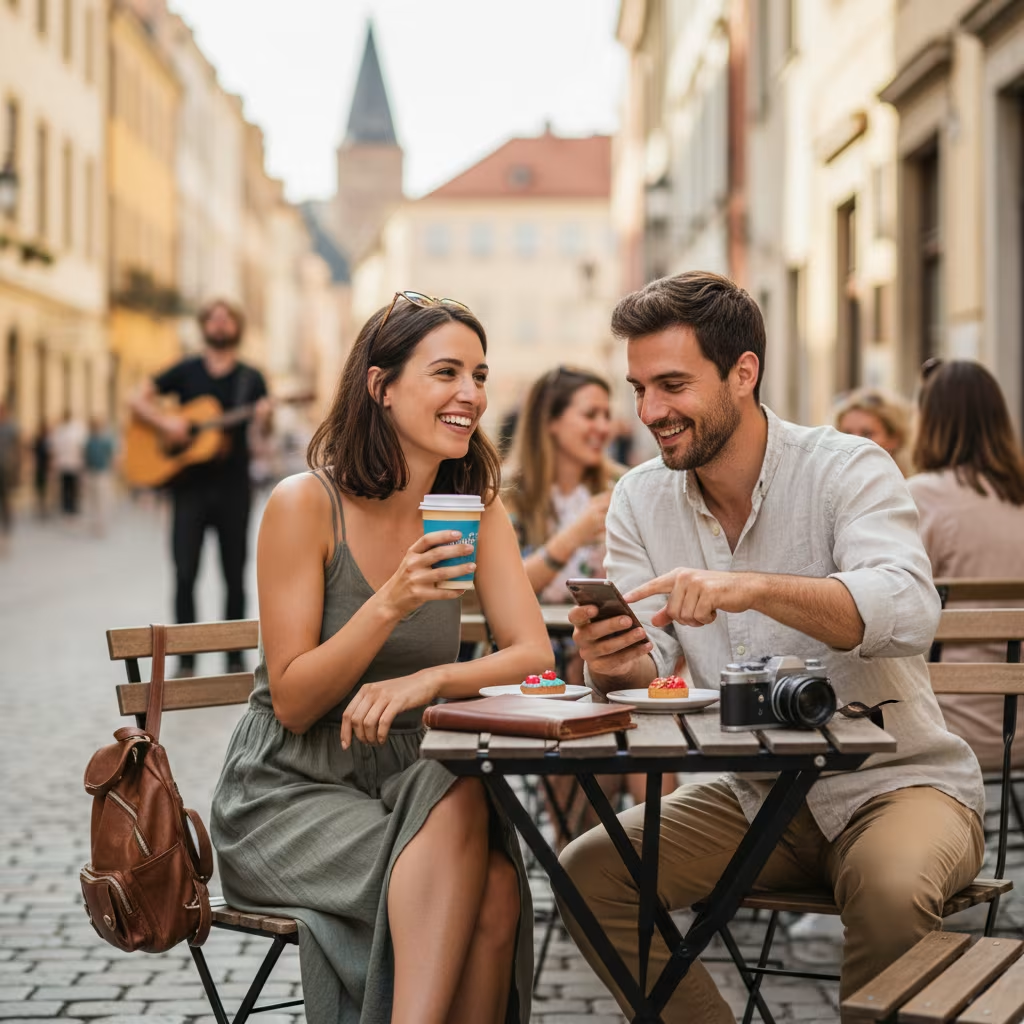
Daily budgets encourage short-term thinking. A $100/day budget for ten days ($1,000) looks the same as a $70/day budget with a $300 splurge reservation, but they feel completely different on the ground. Work out your total number first, then figure out how it distributes. Some days cost more (arrival days, long transit days, a special dinner). Some cost less (slower days, towns with nothing to spend on). Averaging across the whole trip is more realistic than holding a daily target.
2. Research the actual cost floor before you go.
Every destination has a rough cost floor: the cheapest plausible daily spend that still allows a decent experience. You can find this by looking at Numbeo for city cost data, reading recent posts on the Lonely Planet Thorn Tree forums, and checking Hostelworld and Booking.com for price ranges. Don't build your budget on two-year-old blog posts; costs shift, especially post-pandemic.
3. Identify the two or three line items worth protecting.
Based on your joy hierarchy from the first step: these are untouchable. If you need a private room, budget for it. If the one restaurant you've been wanting to try has a tasting menu at $120, put that in the budget before you calculate anything else. Build around your non-negotiables.
4. Apply active cheapness to everything else.
Active cheapness means making deliberate trade-off decisions, not just choosing the cheapest option automatically, but knowing why. The bus instead of the taxi, not because you can't afford the taxi, but because the bus takes you through a neighborhood the taxi doesn't. The market lunch instead of the tourist-square café, not because of the price difference, but because the food is better. Budget decisions that also produce better experiences are not compromises.
5. Use a dedicated travel card with no foreign transaction fees.
Wise (formerly TransferWise) and Charles Schwab (for US travelers) both offer debit cards with no foreign transaction fees and favorable exchange rates. Using a standard credit card abroad typically costs 2–3% per transaction in conversion fees; over a $3,000 trip, that's $60–90 in invisible losses. This is a straightforward fix that requires about 15 minutes to set up before you leave.
6. Track spending daily, but don't police it daily.
Note your spend each evening in a notes app or spreadsheet. The goal isn't to stay under a daily limit but to maintain awareness of where the total is trending. If you've blown past budget in week one but have three weeks left, that awareness gives you time to adjust. If you're only tracking at the end of the trip, there's nothing to adjust.
Three weeks in Portugal on a ten-day budget
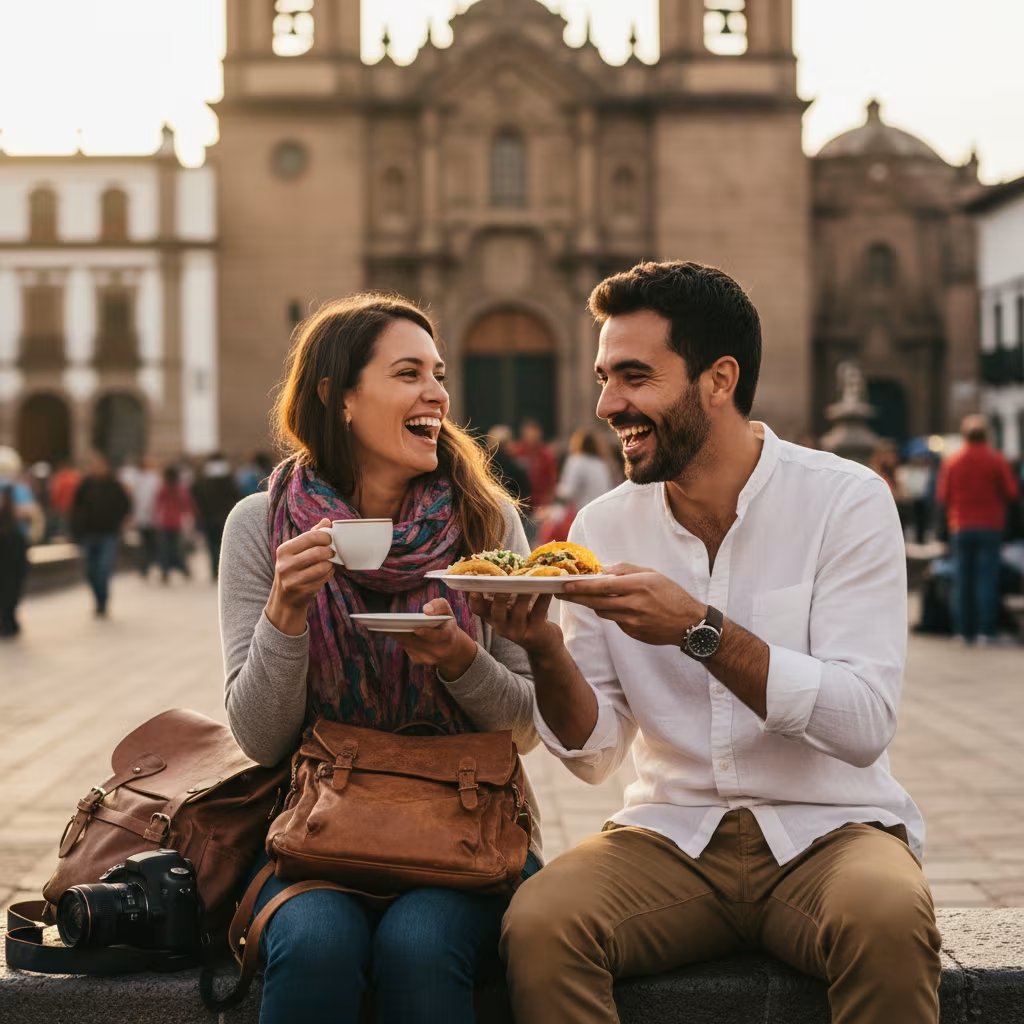
Three weeks in Portugal on a ten-day budget. The key decision I made before arriving was identifying accommodation as my top priority and food as my second, with transportation near the bottom. I rented an apartment in Alfama at twice what a hostel would have cost, ate almost exclusively at local tascas and markets, and walked everywhere in Lisbon (it's a city built for walking). I took one regional train to Porto and one to the Alentejo. The total spend was about 15% over my original daily budget, but the framing error was that I'd set a daily budget. My total trip budget was actually intact because several days (slower days in the Alentejo, a rainy Sunday in Lisbon) came in well under.
A former colleague in Japan. She was convinced Japan would be expensive and nearly cancelled the trip. Her error was projecting European accommodation costs onto Tokyo. She found that business hotels in Japan (compact, immaculate, with excellent beds) run $50–80/night in most cities. Her real cost came in accommodation + food at about $120/day, lower than a comparable quality experience in London. The budget anxiety was based on bad data.
Budget surfing in Morocco. A friend was traveling with a strict $40/day limit in Morocco, which is achievable but squeaky. He protected his line item (a cooking class in Fez, pre-booked at $45) by taking shared grand taxis instead of private transfers, eating at hole-in-the-wall places recommended by his riad host, and skipping the guided tours of the medinas in favor of getting intentionally lost. His memories of that trip are all food and people, not experiences, which, it turns out, was his joy hierarchy all along.
Savings that cost more than they save
Booking the cheapest accommodation in a difficult neighborhood. The savings on a $15/night guesthouse can evaporate if it adds $20/day in taxi costs to reach the places you want to be. Location is a budget decision, not just a comfort one.
Converting every price to your home currency. Once you're traveling, constant mental conversion creates spending paralysis. Know your rough daily budget in local currency and operate in that currency. Checking what everything costs in dollars is a mental tax that doesn't help you make better decisions.
Not accounting for transit days. Airport meals, taxis, luggage storage, early check-in fees: these add up. Transit days routinely cost 30–50% more than exploration days. Build a buffer.
Skipping travel insurance to save money. Travel insurance on a $2,000 trip costs roughly $80–160. A single medical evacuation, without insurance, can cost $50,000–100,000. This is not a line item to optimize.
Expecting budget accommodation to deliver what it can't. A $25/night guesthouse is not a $150/night boutique hotel with fewer amenities. It's a different experience entirely. Go in with calibrated expectations, not aspirational ones.
Cash, cards and the awkward budget questions
Budget planning raises a lot of anxious questions. These are the ones that matter most.
How do I handle cash vs. card in developing countries?
Carry enough cash for two to three days of small expenses: markets, street food, small guesthouses. Use a no-fee card for larger purchases and ATM withdrawals. Avoid airport ATMs, which often have the worst rates; instead, use bank-affiliated ATMs in city centers.
What's the best way to estimate a daily budget for a new destination?
Look at Numbeo for city-level cost data, then search Hostelworld and Booking.com for your accommodation tier and get actual current prices. Add 20% to whatever you calculate: budget estimates from blogs are almost always optimistic.
Is slow travel actually cheaper?
Usually, yes. Moving frequently incurs transaction costs: transport between cities, tourist-area restaurants near bus stations, tourist-area accommodation because you don't know the neighborhoods yet. Staying somewhere for five nights instead of two lets you find the real grocery store, the neighborhood café, and the $3 lunch spot three blocks off the main street.
Should I exchange currency before I leave?
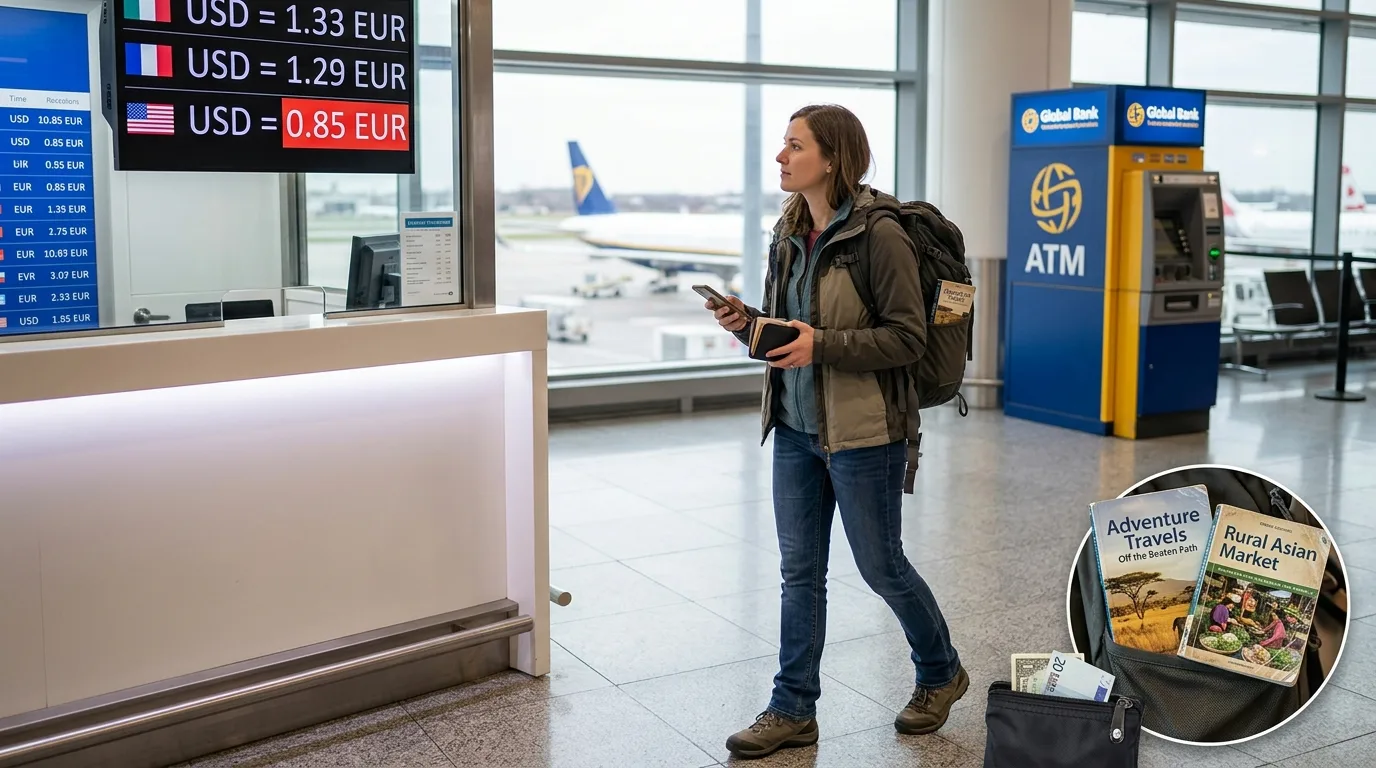
For most major destinations, no: the rates you'll find at an airport exchange booth in your home country are rarely competitive. Use a no-fee ATM card at your destination and withdraw in local currency from a local bank ATM. The exception is destinations where card acceptance is very low (parts of Sub-Saharan Africa, some parts of Southeast Asia); in those cases, bring some US dollars or euros as a backup.
Budget mechanics:
| Principle | Figure |
|---|---|
| Asymmetric cuts | 60% cheaper in some places funds 100% in others |
| Card conversion fees | 2–3%/transaction ≈ $60–90 lost on a $3,000 trip |
| Fix time | ~15 minutes before departure |
| Japan business hotels | $50–80/night, excellent beds |
| Splurge first | a $120 tasting menu goes into the budget before the daily number |

0 Comments
No comments yet — start the conversation.