

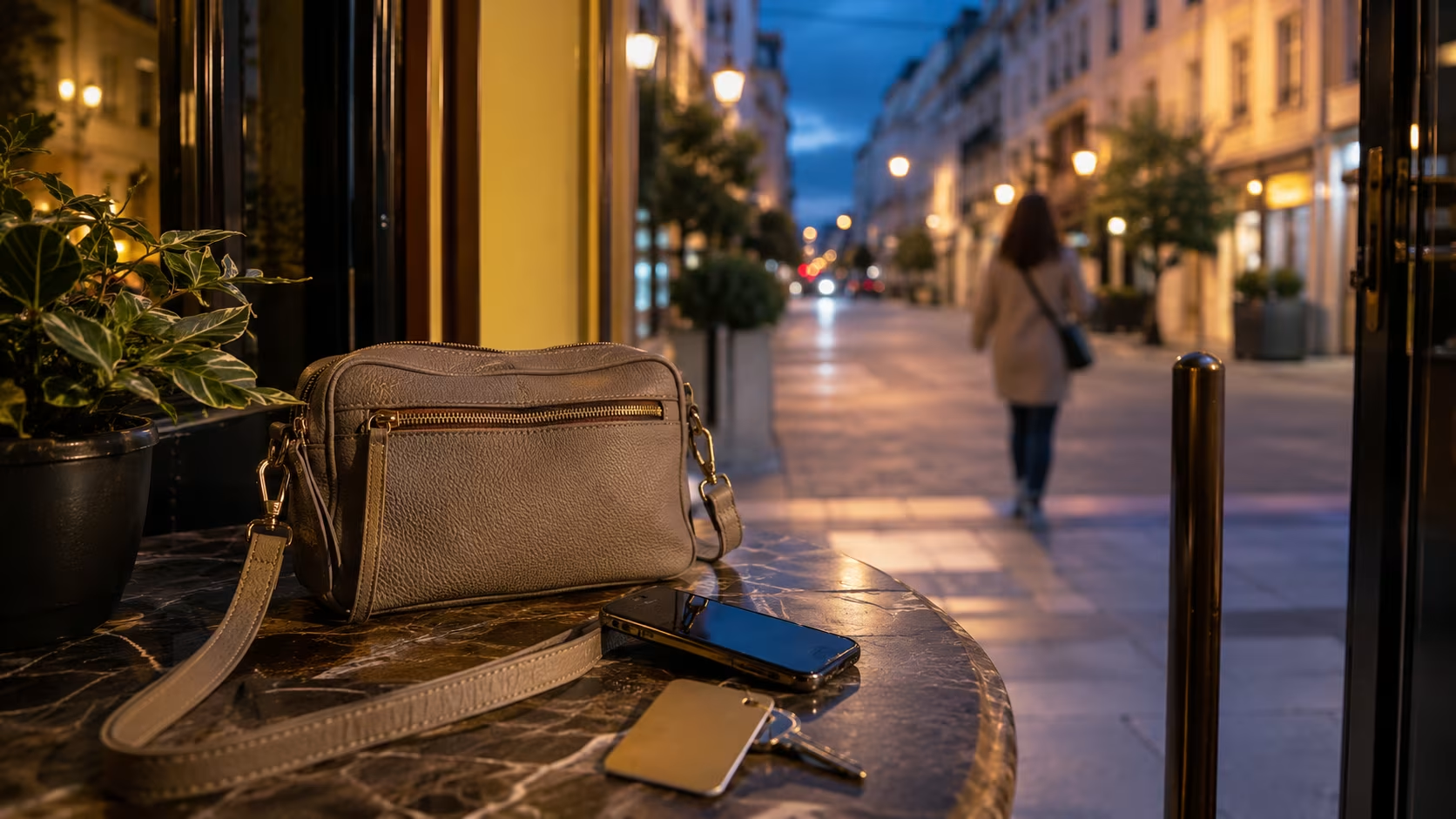
Most solo female travel guides oscillate between two unhelpful poles: cheerful empowerment that pretends every place is equally safe, and fear-mongering checklists that name every possible threat without any sense of probability. Neither helps you travel.
A risk framework is more useful. Decompose risk into categories, weight each by realistic probability and consequence, and apply specific protocols. The same approach intelligence and humanitarian organizations use, scaled down for a tourist.
This is a practical 2026 guide for women traveling alone for leisure or business. It assumes you've done the basics (passport copies, travel insurance, someone at home knows your itinerary). It focuses on the decisions and habits that change actual outcomes.
Risk Decomposes Into Five Categories
| Category | Examples | Probability | Mitigation strategy |
|---|---|---|---|
| Petty theft | Pickpocketing, bag snatching | High in tourist zones | Habits, gear |
| Confidence scams | Fake taxis, distraction tricks | Moderate | Awareness, refusal scripts |
| Harassment / unwanted attention | Catcalling, persistent advances | Variable by region | Avoidance, body language, reframe |
| Sexual assault | Coercion, drugging, attack | Lower than headlines suggest, but consequence high | Accommodation choices, transit choices, never alone with an unknown male in a private space |
| Violent crime | Mugging, kidnapping | Very low for tourists in most destinations | Country-level decisions, time-of-day rules |
Most solo travel anxiety treats all five as equally probable. They're not. Pickpocketing in central Rome is near-certain over a week; a violent crime in central Lisbon is statistically rarer than in your home suburb. Calibrate.
Country-Level Selection
Not every destination is equally safe for a solo female traveler. The data exists; use it.
Reliable sources:
- OSAC (overseas-security-advisory-council.com): US State Department's annual country reports, granular and current.
- GOV.UK Foreign Travel Advice: equivalent, often more detailed for specific cities and regions.
- Australian Smartraveller: well-organized for non-North American travelers.
- Numbeo Crime Index: crowdsourced, useful as a tiebreaker.
General categories (this changes year to year, so always check current advisories):
Lower Risk for Solo Female Travel
Iceland, Japan, South Korea, Singapore, Taiwan, Switzerland, Norway, Portugal, Slovenia, Ireland, Netherlands, Denmark, Finland, New Zealand. Petty theft still happens; violent crime is rare.
Moderate Risk Requiring More Planning
Most of Western Europe (Spain, France, Italy, Germany, UK), Greece, Eastern Europe, much of South America (Argentina, Chile, Uruguay, Peru with caveats), Southeast Asia (Thailand, Vietnam, Malaysia, Indonesia), Mexico (varies sharply by region). All travelable solo with normal precautions.
Higher Risk; Experienced Solo Travelers Only
Parts of Central America, parts of South Asia (rural India, Bangladesh), parts of West Africa, parts of South Africa. Travelable but requires real research and ideally local guidance.
Active Advisory Zones
Don't go solo. Most current Level 4 travel advisories from major governments.
This is not a moral judgment about countries. It's a probabilistic statement about your specific situation as a foreign woman alone. Local women navigate the same places with completely different risk profiles.
Accommodation
This is the single highest-leverage decision after country selection.
What to Look for
Solid front-desk presence. A 24-hour staffed reception is worth the price difference over an unstaffed Airbnb. The friction of someone seeing comings and goings deters most opportunists.
Female-friendly Airbnb signals. Verified host with significant review history (100+ reviews), reviews from solo female travelers, building with secured entry. Avoid hosts who only have private apartments rented out (look for management-company-style profiles instead).
Female-only hostels and dorms. Most major hostel chains (Generator, MEININGER, etc.) offer female-only dorms for the same price. The crowd self-selects in a useful way.
Floor selection. Skip the ground floor in unfamiliar areas; window access is the cheapest break-in route. Skip the top floor in older buildings without elevators; you have only one exit. Floors 2–5 are the sweet spot.
Door specifics. A peephole, a chain, and a deadbolt that engages from inside. If your door doesn't have all three, request a different room.
What to Avoid
- Last-minute walk-up bookings in unfamiliar countries
- Listings with vague locations ("near city center")
- Hosts with no profile photo and few reviews
- Buildings without secured entry where the door code is in the public-facing booking confirmation
- Anywhere reviews mention "creepy host" or "awkward attention"; believe the first review that says it
Transit
How you move around at night is one of the strongest single signals you'll send.
Day Vs. Night Protocols
Daytime. Walk almost anywhere central. Public transit unrestricted. Take stock of the neighborhood's energy; quiet is fine, deserted is a signal.
After sunset. Tighter rules. Use rideshare apps (Uber, Bolt, Lyft, regional equivalents) over hailed taxis. Their tracking and accountability changes the dynamic. Verify the license plate before getting in. If a driver isn't who the app says, cancel and walk away.
After 22:00 or alone. No empty subway cars, no walking down empty streets between transit and your hotel, no third drink unless you're in your own accommodation.
Specific Transit Warnings
Unmarked taxis at airports and stations. A common scam in many countries. Use the official taxi line (regulated meters), pre-booked transfer, or rideshare app pickup zone.
Sleeper trains in unfamiliar countries. Book the female-only or female-friendly carriage where it exists (Russian, Indian, and some European rail networks all have these). When booking online, sometimes the option appears only after you specify gender.
Long-distance buses. Generally safer than they look in most of South America and Southeast Asia. Choose night routes with reputable companies (Cruz del Sur in Peru, Greyhound's Mexican equivalents, etc.). Premium-tier buses have far better safety records than budget operators.
The Drinking Rule
More solo travel incidents involve alcohol than any other single factor. The rule, simply: two drinks max in a public space where you don't know everyone, and never a drink someone else handed you.
This isn't about restraint. It's about reaction time and decision-making. The arithmetic:
- Two drinks = your judgment is intact, your reflexes are slowed but functional.
- Three drinks = you start to misread situations and people.
- Drug-spiked drink = the same loss of agency in five minutes.
The best drink protocol:
- Watch your drink poured.
- Keep your hand on it.
- If you leave it, it's done. Order a new one.
- If you start feeling much drunker than you should given what you drank, leave immediately. Tell the bar staff. Tell someone outside.
Spiking is rare in absolute terms but consequential. Treat it the way pilots treat near-zero-probability emergencies: you build the protocol so the bad outcome can't happen, even if you're 99.9% likely to never see it.
Body Language and Reframing
Most harassment in tourist zones is opportunistic, not predatory. The opportunist scans for signals: walking slowly, looking lost, alone, headphones in, eyes on phone. Removing those signals removes most of the unwanted contact.
The walk. A neutral, purposeful walk reads as "this person is local enough." Even if you have no idea where you're going, walk like you're 30 seconds from arriving. Look up at street signs only briefly; don't pull out a map on a busy street.
The look. Sunglasses are useful. They block the eye contact opportunists wait for. They also make it harder to read your reaction.
Phone use. Standing still on the sidewalk staring at your phone marks you. If you need to navigate, step into a café or doorway, sort it out, then continue.
Refusal language. A clear "No, thank you" works in most languages. Do not soften it with smiles, apologies, or explanations. The opportunist reads explanation as engagement and tries again.
The reframe. Most catcalling and street comments are about the catcaller's social performance, not about you. They want to be seen by their friends doing it. Walking past silently denies them the audience response.
What to Pack
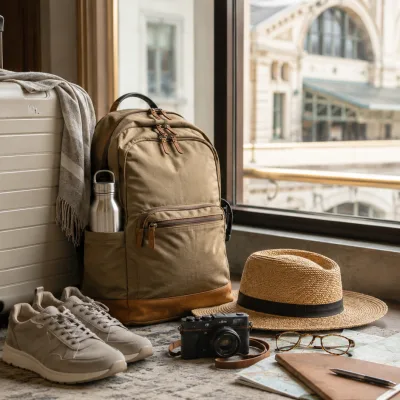
Travel safety gear is more about reducing temptation than fighting back.
| Item | Purpose |
|---|---|
| Crossbody bag with lockable zipper | Pickpocket deterrent |
| Door wedge or portable door alarm | Hotel/Airbnb extra security |
| Whistle | Public attention if needed |
| Decoy wallet | A small wallet with a few small bills to hand over if mugged |
| Tile or AirTag in main bag | Track if stolen |
| Fake wedding ring | Reduces unwanted attention in some regions |
| Photocopies of passport and key cards | Stored separately from originals |
Skip:
- Pepper spray (illegal in many countries; complications if you're carrying it through airports without the right plan).
- Knives (similar story; rarely useful).
- Anything that signals wealth (designer logos, expensive jewelry, premium brand luggage).
The Buddy System (without a Buddy)
Solo travel doesn't have to mean isolated travel. Tools that approximate a buddy:
Live location sharing. Always have one person you trust knowing your real-time location for the trip. Apple's Find My or Google's location sharing both work. Set it for the duration, not for individual outings.
Daily check-in. A short message every day, even "in Lisbon, slept fine, going to Sintra today." The point isn't drama; it's a baseline. Missed check-ins trigger concern.
Pre-arranged contact protocol. Tell your trusted person what "missing for X hours" means and what to do. "If I haven't responded in 24 hours and you can't reach me, contact this hotel and the embassy."
Local emergency numbers in your phone. 112 across Europe; 911 across North America; country-specific elsewhere. Save your country's embassy phone number in the destination capital.
Travel insurance with evacuation coverage. Real medical evacuation can cost $50,000–$250,000. Standard travel insurance often doesn't cover it. Premium plans (Allianz, World Nomads, SafetyWing) include real coverage starting around $10/day.
Specific Scenarios
A Man You've Just Met Wants to Walk You Back to Your Hotel
Decline. "I'm fine, thanks." If they insist, walk into a shop or café and stay until they leave. Never lead someone unknown to where you sleep.
Your Taxi is Taking an Unfamiliar Route
Open Google Maps, calmly say "I'd like to go via [route]." If the driver doesn't comply, ask to be let out at a known landmark (a major hotel, a public station). Pay if necessary; get out.
Someone is Following You
Change direction sharply. Walk into the brightest, busiest place you can find: a hotel lobby, a café, a 24-hour pharmacy. Tell staff you'd like to wait there for ten minutes. Most stalkers disengage when their target stops being an easy mark.
You Wake up to Someone in Your Room
Don't pretend to be asleep. Yell loudly, deliberately, in any language. Most opportunistic intruders flee at the first noise. Have your phone bedside-charged so you can call emergency services immediately.
You Realize Your Drink was Spiked
Get to a public, well-lit place. Tell anyone (bartender, security, another customer) that you think you've been drugged and need help getting safely out. Do not go anywhere alone. Call your trusted contact. Get to your hotel via rideshare with location-share active.
You're Catcalled or Harassed
Don't engage. Don't make eye contact. Don't reply. Walk into the nearest open business if it's persistent. Filming with your phone often defuses: most catcallers don't want to be on record.
Long-Term Travelers Vs. Two-Week Trips
Solo women traveling for months calibrate differently than two-week tourists.
Long-term:
- Build local relationships in each base (gym, language exchange, regular café).
- Stay 2+ weeks per location instead of moving every 3 days; you stop reading like a tourist by week two.
- Find one trusted local contact in each city. Restaurant owner, hostel manager, language school admin.
- Keep a base-level fitness routine. Strength matters less than confidence, but confidence comes partly from physical capability.
Two-week:
- Most of the above doesn't have time to develop. Compensate with tighter planning and stricter protocols.
- Stay in one city or one region; resist the urge to do four cities in two weeks.
- Use the established tourist infrastructure (trusted hotels, official transit) more.
- Skip nightlife in unfamiliar cities. The risk-reward is poor for a one-week visit.
What Doesn't Help
Advice that survives the internet but not the data:
"Just trust your gut." Useful, but only if your gut has been calibrated by enough travel to recognize specifics. New travelers' guts produce both false alarms and false safety; the framework above adds external structure.
"Dress like the locals." Helps marginally. The body language and walk matter more.
"Don't be afraid to ask for help." Asking for help from the wrong person is exactly how some scams start. Ask staff at established businesses. Don't ask the man on the street.
"Always wear a hidden money belt." They were useful in 2005. In 2026 a phone with offline maps, a credit card with chip-and-PIN, and a backup card in your accommodation safe is more practical.
Final Notes
The stories that haunt solo female travel guides are real but rare. The everyday experience is closer to: light catcalling in a few specific neighborhoods, occasional staring, a string of pleasant encounters with locals and other travelers, and a low background hum of vigilance that becomes second nature within a week.
The framework above is not designed to make you afraid. It's designed to make the fear precise. Generalized anxiety leaves you exhausted and defensive about everything; specific risk awareness leaves you free to enjoy almost everything because you've already pre-decided how you'll handle the small fraction that requires attention.
The quietest piece of advice in solo female travel: most women who do it once do it again. The sample-of-one experience often overrides the worst-case-narrative dread. Plan well, calibrate, then go.
Sources and verification
Check current details with these primary or subject-authority sources before acting on the information.
0 Comments
No comments yet — start the conversation.