

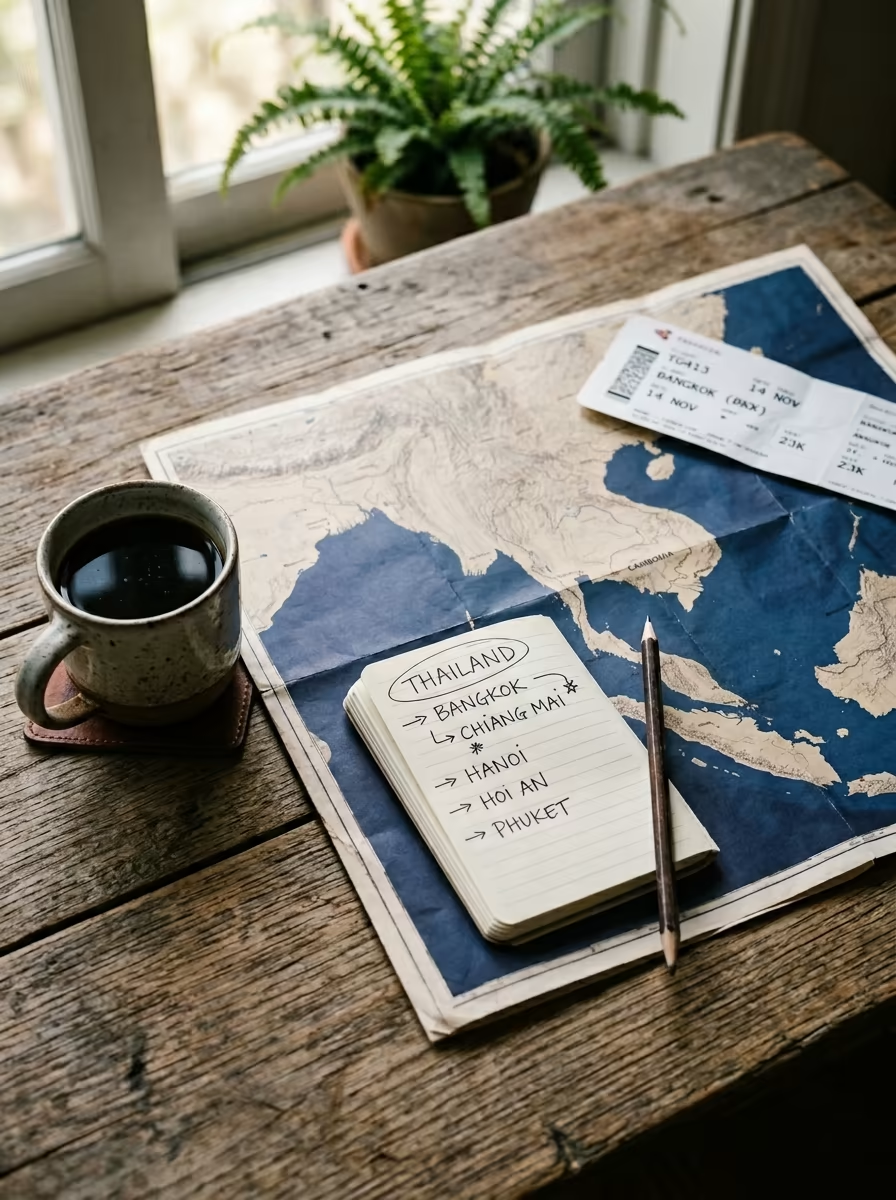

The email sat in my inbox for three days before I answered it. My friend Elena was planning her first long trip (six weeks, four countries in Southeast Asia), and she was ready to hand everything to a tour operator and pay a 30% premium for the comfort of someone else making decisions. I told her to wait. Not because agencies are bad, but because what she was actually buying was the illusion of control over something that doesn't need controlling. Three months later she did the whole trip herself, spent less than half what the package would have cost, and arrived in Chiang Mai two days earlier than originally planned because she found a connection that the operator's fixed itinerary couldn't accommodate.
Self-booking a multi-country trip is genuinely achievable for anyone who can navigate a spreadsheet and is willing to spend four or five hours on research before touching a booking form. The work is front-loaded. Once you understand the sequence, and more importantly, what not to lock in early, the whole thing comes together faster than you'd expect.
This isn't a guide for people who want someone to think for them. It's for people who want to think clearly.
The booking hierarchy that removes the panic
The single biggest mistake travelers make when planning multi-country trips is treating all their bookings as equally urgent. They either book everything months out (locking themselves into an inflexible structure) or they book nothing (arriving at destinations during peak season to find accommodation has tripled in price).
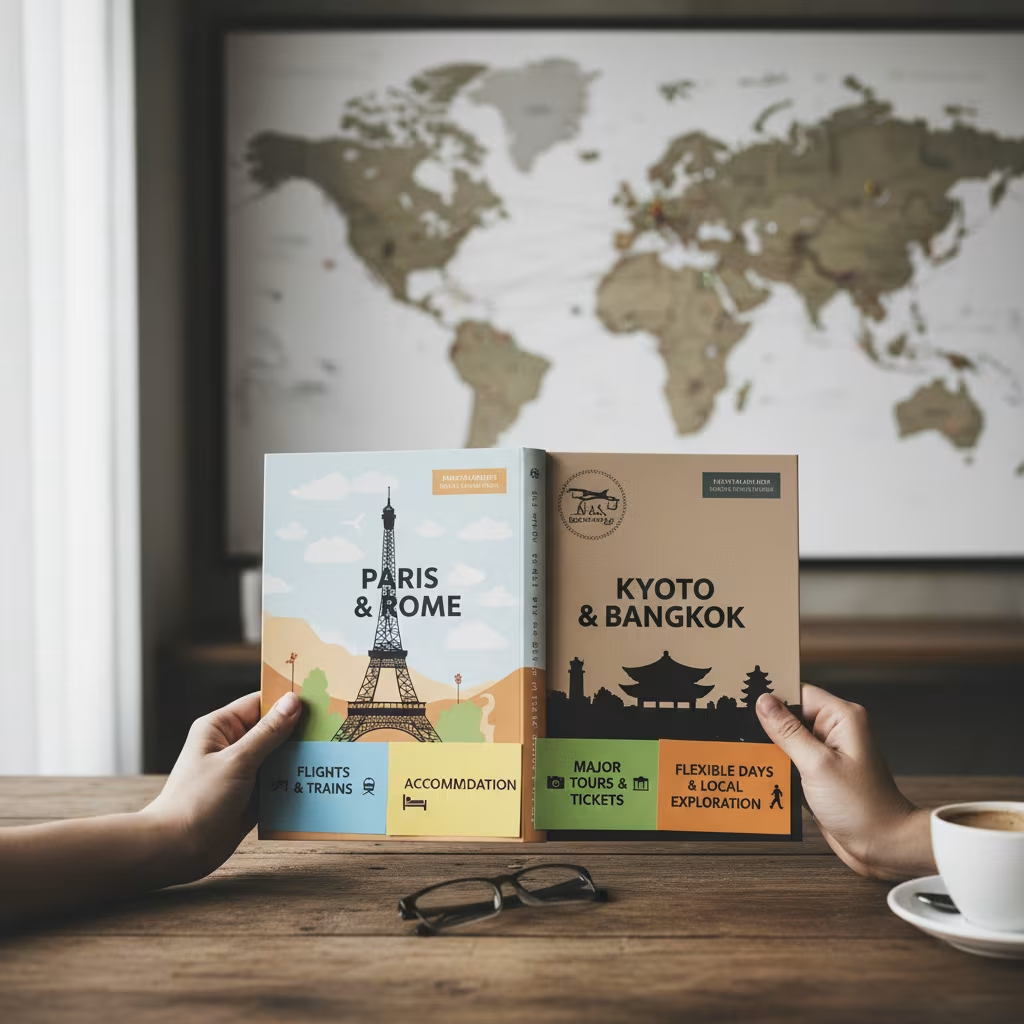
The correct framework is a booking hierarchy: some things must be fixed, some things should be reserved but flexible, and some things are best left open entirely.
Must-fix Early
International flights (especially opening and closing legs), any overnight train or ferry with limited capacity, and accommodation for your first two nights in each new country. These are the structural load-bearing elements of your trip. Changing them later costs real money.
Reserve but Keep Flexible
Internal transportation for legs where you have a rough date but might shift by a day or two. Many rail systems in Europe and Japan allow date changes for a modest fee, which is worth paying for the flexibility. Book these 4–6 weeks out.
Leave Open
Day excursions, city-to-city bus routes in Southeast Asia (abundant and bookable same-day), most restaurant reservations outside of a handful of famous places, and your final nights if you might extend. The anxiety of having nothing booked for week four of a six-week trip is largely unfounded: the options are nearly always there.
This hierarchy sounds obvious until you're actually staring at a booking form with a flexible date and the urge to just commit. The principle to hold onto: book what will sell out, flex what won't.

The order to book things in
1. Build your route before touching a booking site.
Open a blank document (not Kayak, not Google Flights, a blank document) and write out your countries in order. Then write the cities. Then write a rough number of nights next to each one. Only when that sequence feels right do you move to booking. The single biggest time-waster in trip planning is searching for flights before you know your route, because every search result tempts you to adjust a route that hasn't been thought through yet.
2. Find your international flights first, then build the internal route around them.
International hubs have far more pricing leverage than internal connections. Lock in your entry and exit country: these determine everything else. Use Google Flights' explore map to get a sense of price ranges, then book directly with the airline or through a major OTA (Expedia, Booking.com's flight tool). Avoid third-party aggregators for intra-country flights in regions like Southeast Asia and South America. They add 8–15% in fees and provide no customer service if the airline changes the schedule.
3. Research visa requirements before you book anything.
This step sounds administrative, but it has real routing consequences. Some nationalities cannot enter certain countries without pre-arranged visas that take three to six weeks to process. Some countries require proof of onward travel before they'll issue a visa on arrival. Run every country on your list through your government's official travel advisory site (the UK Foreign Office, the US State Department, or the EU's equivalent) before you commit to a sequence.
4. Use the national rail site for train bookings, not aggregators.
In Europe: Renfe for Spain, Trenitalia or Italo for Italy, SNCF for France, DB Bahn for Germany. These sites are clunky and occasionally require a VPN to book as a non-local, but they are the authoritative source and prices are meaningfully lower. Book intra-country trains 30–60 days out for best prices on high-speed routes; regional trains rarely need advance booking.
5. Set up a simple tracking spreadsheet.
Four columns: Date, Location, Booking type, Confirmation number. Add a fifth column for cost if you're budget-tracking. Share it with someone at home who has your itinerary. This is your emergency reference, not your planning tool: the planning lives in your head and your document, and the spreadsheet just records what you've actually committed to.
6. Keep a "parking lot" of things to book later.
A second tab in the spreadsheet. Every time you find an activity or restaurant you want but don't need to book yet, it goes here. This prevents the anxiety of forgetting while also preventing premature booking.
Elena's six weeks in Southeast Asia, replanned
Elena's Southeast Asia trip. When she finally started planning herself, the first thing I told her to do was write the route before opening any booking site. Her original fantasy was: Bangkok → Chiang Mai → Luang Prabang → Hanoi → Hoi An → Ho Chi Minh City. After two hours of reading about border crossings, she realized the Bangkok opening leg was adding three days and considerable cost, and that flying into Chiang Mai directly (via Singapore on a budget carrier) saved both. She booked international flights, the two Laos nights of accommodation, and the Hanoi → Hoi An train; everything else she left open. Total planning time before the trip: about six hours. Total savings versus the packaged itinerary she'd nearly bought: around $900.
Marcus in the Balkans. He tried to book everything at once and found himself staring at a web of conflicting dates at two in the morning. His mistake: he'd started with accommodation instead of flights, so every hotel booking was provisional until he had confirmed travel times. Once he reversed the sequence (flights first, accommodation after), the whole thing settled in two evenings.
A solo trip through the Caucasus. Georgia, Armenia, and Azerbaijan require some advance thought because the Georgia-Azerbaijan land border is easy but the Armenia-Azerbaijan border is closed for political reasons, a routing error that catches people every year. Five minutes on a government travel advisory site would have flagged this. It didn't catch me; I'd read a traveler's blog that was three years out of date and had to change my route after arriving in Tbilisi.
Where self-planners lose money
Starting with accommodation. Hotels are flexible; flights are not. Always price and confirm flights before booking accommodation around them.
Trusting travel blogs for visa information. Blog posts go out of date within months and are not legally authoritative. Use your country's official government travel advisory site for visa requirements, and check it within 60 days of travel, since policies change.
Booking every internal connection months in advance. In most of Southeast Asia, East Africa, and South America, internal transportation is abundant and same-day or same-week bookable. Locking in a specific bus on a specific day six weeks out gains you almost nothing and costs you flexibility.
Underestimating ground-travel time. The romance of overland travel is real, but a "quick" bus between two cities in Central America can take eight hours due to border formalities. Build buffer days at borders.
Not reading cancellation policies. This is not glamorous advice, but booking a fully non-refundable hotel for your first night in a new country, when your inbound flight still might be delayed or cancelled, is an unnecessary risk. Pay a small premium for flexible rates on critical first and last nights.
Before you book: the questions that keep coming up
Self-booking a multi-country trip raises a consistent set of questions. Here are the ones I hear most often.
How far in advance should I start planning?
For a trip of three weeks or more, start building the route concept three to four months out. Begin actual bookings, international flights first, about two to three months before departure. Internal bookings can follow over the next six weeks.
What if something goes wrong mid-trip?
Travel insurance is not optional on a multi-country trip, and it should include trip interruption coverage, not just medical. The cost is typically 5–8% of your total trip cost. Keep digital and physical copies of all booking confirmations.
Should I get an international SIM or use eSIM?
For trips crossing multiple countries, an eSIM from Airalo or a similar multi-country provider is now the most practical option. It covers most regions for $15–25 per month and saves you the hassle of buying local SIMs at each border.
Is it worth booking a guided day tour for certain sites?
Yes, for a small number of high-context sites (Angkor Wat, the Uffizi, Petra) where a knowledgeable local guide genuinely adds comprehension. For most destinations, however, a good guidebook and your own pace will serve you better than a group tour.
Sources and verification
Check current details with these primary or subject-authority sources before acting on the information.
Booking order and margins:
| Item | Figure |
|---|---|
| Third-party flight resellers | add 8–15% in fees, no support |
| High-speed trains | book 30–60 days out |
| Travel insurance | 5–8% of trip cost |
| Regional eSIM | $15–25/month |
| Saved vs. packaged tour (real case) | ~$900 on 6 weeks / 4 countries |



0 Comments
No comments yet — start the conversation.